In this piece
- Three bands of particle size, from a single machine
- Calcium hardness inside a 50-to-175 ppm window
- Contact geometry and time, with the grind as the adjustment
- Scales, kettles and the rest, bought for repeatability rather than extraction
- The bean line, up 10.7% in twelve months
- Five purchases, each against its own limit
- The full-immersion ceiling near 21%, past the reach of the next purchase
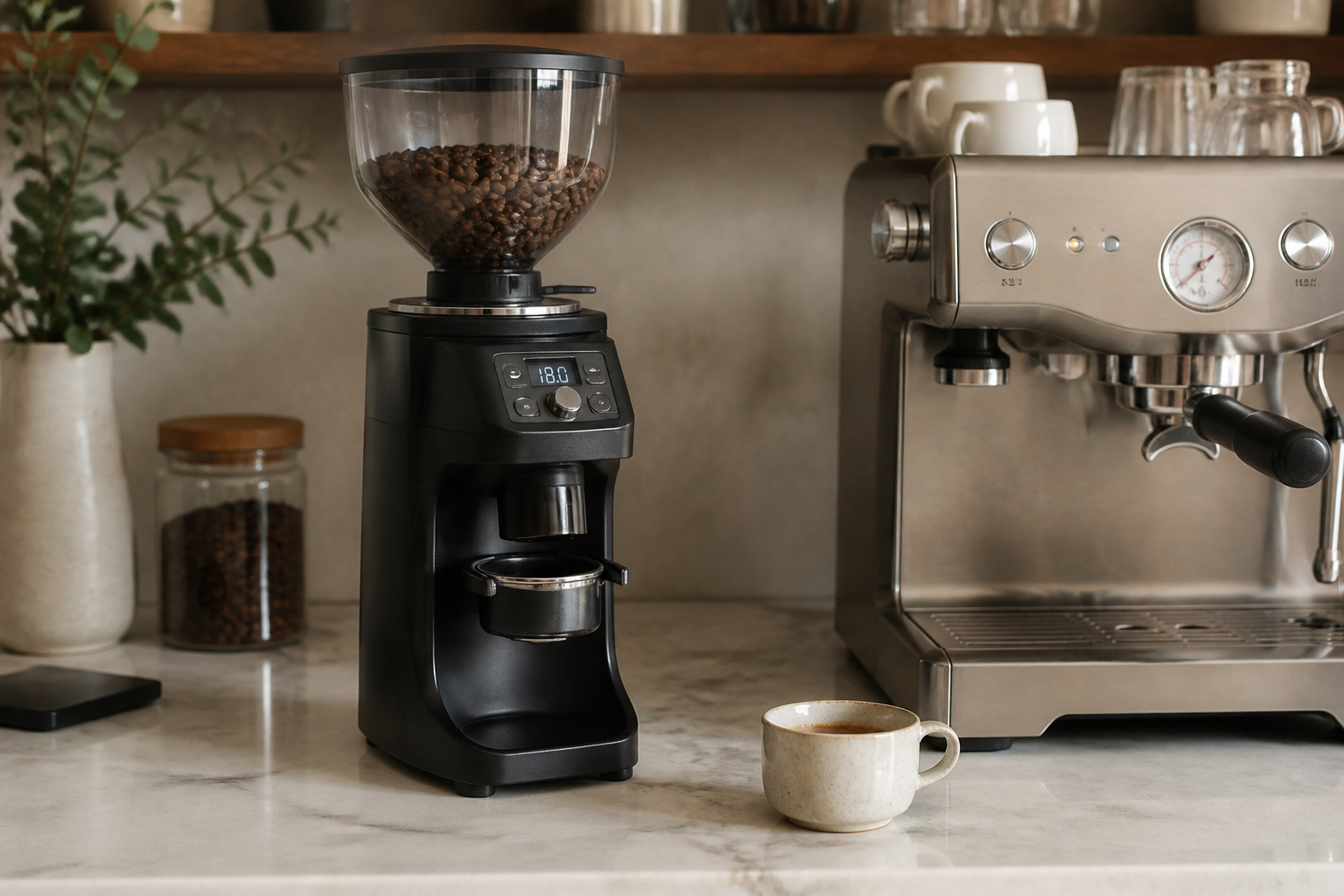
Whatever else a setup has on it, one purchase decides the spread of particle sizes the water works through. A certification standard for home electric filter brewers puts that spread in three bands at once — under 12% above 850 microns, at least 68% between 425 and 850, no more than 20% below — and nothing bought later moves it.
Three bands of particle size, from a single machine
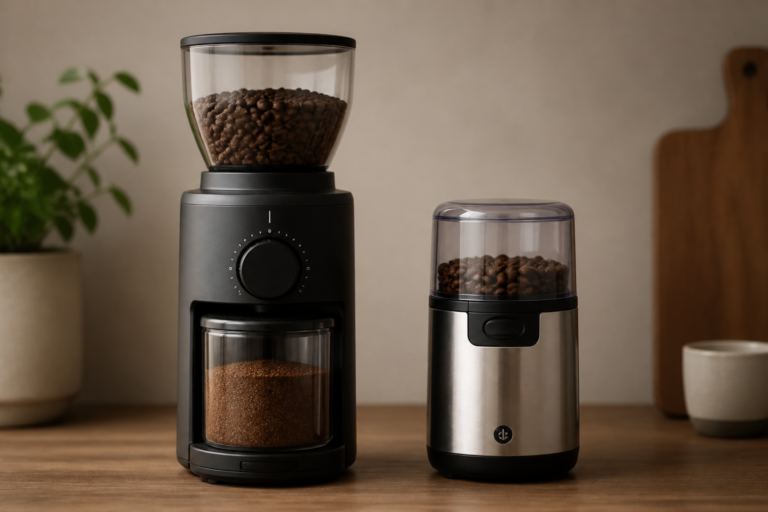
The first purchase has more to work with than the second, and the reason is mechanical. SCA Standard 310-2021 sets the test grind as a distribution, not a setting. For a conical brew basket, under 12% of the grounds by mass may sit above 850 microns. At least 68% must fall between 425 and 850, and 20% or less below 425. The standard covers electric filter brewers designed for home use. Pour-over devices, French press, home espresso machines and pod brewers are excluded from it by name. The Specialty Coffee Association, an industry association, wrote the standard. The copy that loads is a public verbatim mirror, because the association’s own link returns a 404 and its standards page lists the document as member-only.
Three constraints held at once is a specification for a machine. Burr geometry and motor speed decide how much of a dose lands in each band. That is why the same dose leaves two grinders distributed differently.
Calcium hardness inside a 50-to-175 ppm window
The same standard says what the water has to be before any of this gets tested: odor-free, free of chlorine, calcium hardness equivalent to 50 to 175 ppm as calcium carbonate, alkalinity 40 to 70 ppm, and pH between 6 and 8. The provenance caveat repeats, because this is the same member-only document read from the same public mirror. It is a condition of a laboratory test, not a promise about flavor. Water sets what the brew can dissolve. What the water is already carrying when it meets the grounds decides how much of that room is left.
Contact geometry and time, with the grind as the adjustment
A brewer governs temperature history and bed shape. The standard requires the slurry to reach 90 to 96°C. It has to be there by the moment 33% of the water has been sprayed onto the coffee. Then it holds that range for the rest of the cycle. Narrow, and checkable. Then watch the test procedure when a brewer misses its targets. It adjusts the grind, within the three bands above, and runs the test again. The document treats the brewer as the fixed thing and the grind as the variable one. That is a buying order, written into a test method by people with no stake in anybody’s budget.
Scales, kettles and the rest, bought for repeatability rather than extraction
Past the brewer, the money buys measurement. A scale holds the standard brew ratio — 55 g of coffee per 1.000 kg of water — at the same figure every morning. That is worth doing. It is not the same act as changing the cup.
The standard and the study answer different questions, and both deserve naming. The association fixes a three-band particle spec as a control variable — its own words are that the distribution is “chosen to systematize the testing process” — and sets no extraction-yield target at all. A 2021 paper in the peer-reviewed journal Scientific Reports, whose senior author sat on the standard’s expert group, measured full immersion brews at equilibrium and reported extraction yield near 21%. The spread was about 19 to 23%, across median particle sizes from 580 to 1,310 microns — a 730-micron span. Finer grounds did extract more. The effect was small enough that the authors name brew ratio, not grind, as the parameter to watch.
Scope decides which one applies. That study measures immersion at equilibrium; a drip brewer passes its water through the bed once. The standard’s own conditions of household use assume at least 65% of the grounds between 589 and 1,168 microns.
The bean line, up 10.7% in twelve months
One line in this chain recurs, and no purchase controls it. The Bureau of Labor Statistics priced ground roast coffee at $9.317 a pound in July 2026, a U.S. city average, not seasonally adjusted. The same series read $8.414 in July 2025, which makes the twelve-month rise 10.7%. The series covers 100% ground roast coffee, all sizes. Equipment gets bought once and argued about afterwards. The beans get bought again on Saturday.
Five purchases, each against its own limit
| Purchase, in order | What it governs, and the published figure | What it does not govern, at any price |
|---|---|---|
| Grinder | Particle size distribution: ≤12% by mass above 850 µm, ≥68% between 425–850 µm, ≤20% below 425 µm (SCA 310-2021, conical basket) | Extraction yield at equilibrium in full immersion — a 580–1,310 µm span of median size moved it by no more than about four points, 19–23%, around a ceiling near 21% |
| Water | What the brew may dissolve: calcium hardness 50–175 ppm CaCO₃, alkalinity 40–70 ppm CaCO₃, pH 6–8, odor-free and chlorine-free (SCA 310-2021) | Slurry temperature, which the same standard assigns to the brewer at 90–96°C |
| Brewer | Contact geometry and temperature history: slurry at 90–96°C by the moment 33% of the water is sprayed, held for the rest of the cycle (SCA 310-2021) | The grind — the standard’s test adjusts the grind to the brewer, never the brewer to the grind |
| Scale and kettle | Repeatability of the standard brew ratio, 55 g of coffee per 1.000 kg of water (SCA 310-2021) | Extraction yield: ratio moves brew strength, and in full immersion leaves yield near 21% |
| Beans (recurring) | The only recurring line: $9.317 per lb, July 2026, ground roast, all sizes (BLS APU0000717311) | Distribution, dissolved load or temperature — a bean price moves none of them; the line simply repeats, up 10.7% from $8.414 in July 2025 |
Every figure in that table is from SCA Standard 310-2021, the Scientific Reports paper or BLS series APU0000717311.
This ordering assumes an electric filter brewer at household scale, the only kind the standard covers, and water that arrives drinkable. It says nothing about hand grinders bought in place of electric ones, nothing about used equipment, and nothing about a supply that needs treating first. It also assumes somebody intends to taste the difference. That is a claim about a person, not a machine.
The short version
The full-immersion ceiling near 21%, past the reach of the next purchase
Full immersion has an extraction ceiling, and money reaches it early. In the immersion measurements above it sits near 21%. A 730-micron span of grind moved it by no more than about four percentage points. So spend where a component still governs something no other component can reach. The distribution first, then what the water can dissolve, then the temperature and the bed. After that the purchases buy repeatability, which is worth owning as long as nobody sells it as flavor.
Article sources
- Specialty Coffee Association, Standard 310-2021, Home Coffee Brewers: Specifications and Test Methods (public verbatim mirror; the SCA’s own copy returns 404 and the standard is listed member-only)
- Liang, J., Chan, K.C. & Ristenpart, W.D., An equilibrium desorption model for the strength and extraction yield of full immersion brewed coffee, Scientific Reports, 25 March 2021
- U.S. Bureau of Labor Statistics, Average Price Data, series APU0000717311, Coffee, 100%, ground roast, all sizes, per lb. (453.6 gm), U.S. city average