Bills & Beans

Straight Talk on Coffee, Money, and Liberty

Tag: Gear & Buying

A purchase or equipment decision – what to buy, what to skip, and what the difference is worth.

  • The Grinder Comes First: How to Spend a Coffee Budget in the Right Order

    The Grinder Comes First: How to Spend a Coffee Budget in the Right Order

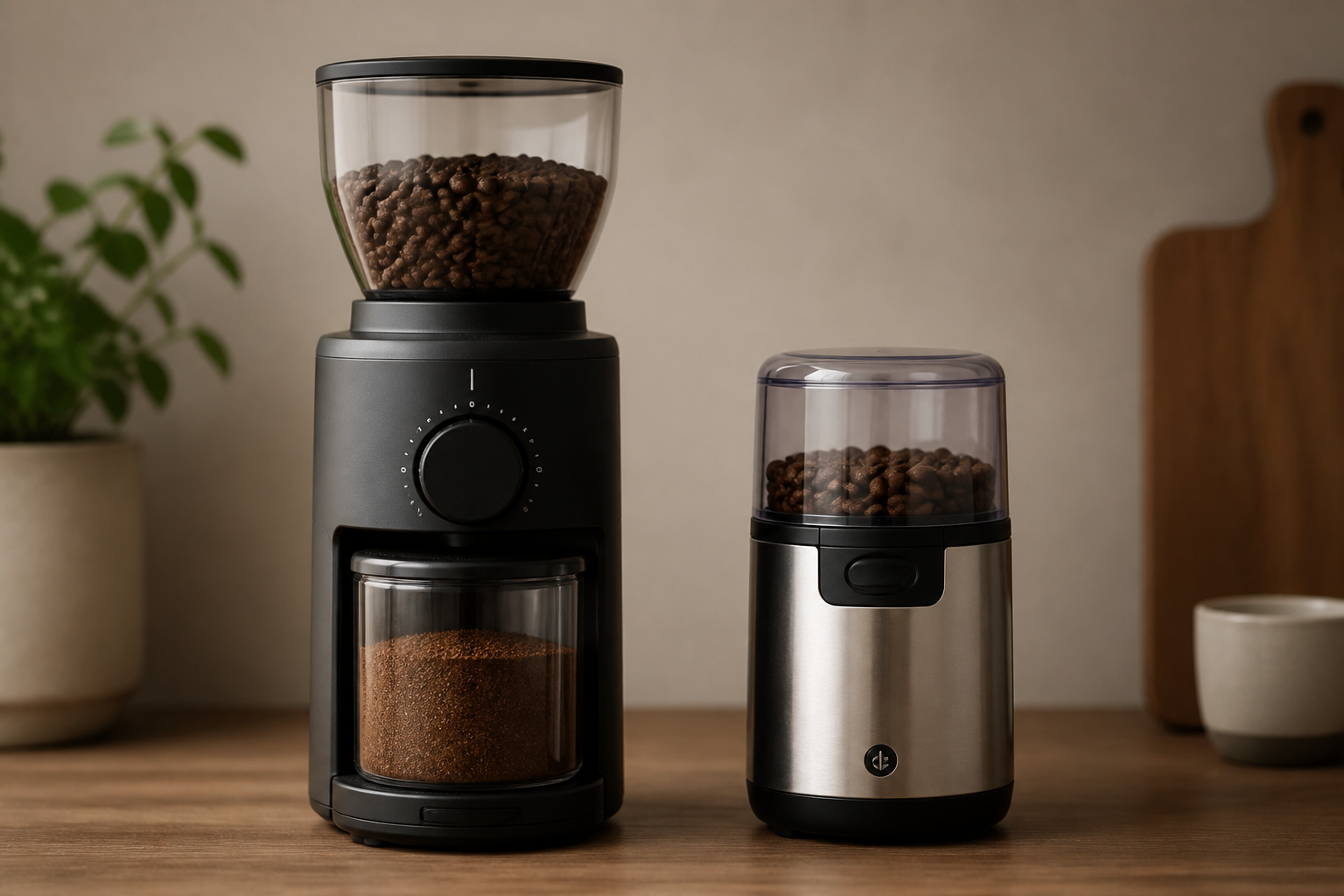
    A black electric burr grinder full of beans in the foreground of a marble counter, a stainless espresso machine out of focus behind it

    Whatever else a setup has on it, one purchase decides the spread of particle sizes the water works through. A certification standard for home electric filter brewers puts that spread in three bands at once — under 12% above 850 microns, at least 68% between 425 and 850, no more than 20% below — and nothing bought later moves it.

    Three bands of particle size, from a single machine

    The first purchase has more to work with than the second, and the reason is mechanical. SCA Standard 310-2021 sets the test grind as a distribution, not a setting. For a conical brew basket, under 12% of the grounds by mass may sit above 850 microns. At least 68% must fall between 425 and 850, and 20% or less below 425. The standard covers electric filter brewers designed for home use. Pour-over devices, French press, home espresso machines and pod brewers are excluded from it by name. The Specialty Coffee Association, an industry association, wrote the standard. The copy that loads is a public verbatim mirror, because the association’s own link returns a 404 and its standards page lists the document as member-only.

    Advertisement

    Three constraints held at once is a specification for a machine. Burr geometry and motor speed decide how much of a dose lands in each band. That is why the same dose leaves two grinders distributed differently.

    Calcium hardness inside a 50-to-175 ppm window

    The same standard says what the water has to be before any of this gets tested: odor-free, free of chlorine, calcium hardness equivalent to 50 to 175 ppm as calcium carbonate, alkalinity 40 to 70 ppm, and pH between 6 and 8. The provenance caveat repeats, because this is the same member-only document read from the same public mirror. It is a condition of a laboratory test, not a promise about flavor. Water sets what the brew can dissolve. What the water is already carrying when it meets the grounds decides how much of that room is left.

    Contact geometry and time, with the grind as the adjustment

    A brewer governs temperature history and bed shape. The standard requires the slurry to reach 90 to 96°C. It has to be there by the moment 33% of the water has been sprayed onto the coffee. Then it holds that range for the rest of the cycle. Narrow, and checkable. Then watch the test procedure when a brewer misses its targets. It adjusts the grind, within the three bands above, and runs the test again. The document treats the brewer as the fixed thing and the grind as the variable one. That is a buying order, written into a test method by people with no stake in anybody’s budget.

    Scales, kettles and the rest, bought for repeatability rather than extraction

    Past the brewer, the money buys measurement. A scale holds the standard brew ratio — 55 g of coffee per 1.000 kg of water — at the same figure every morning. That is worth doing. It is not the same act as changing the cup.

    The standard and the study answer different questions, and both deserve naming. The association fixes a three-band particle spec as a control variable — its own words are that the distribution is “chosen to systematize the testing process” — and sets no extraction-yield target at all. A 2021 paper in the peer-reviewed journal Scientific Reports, whose senior author sat on the standard’s expert group, measured full immersion brews at equilibrium and reported extraction yield near 21%. The spread was about 19 to 23%, across median particle sizes from 580 to 1,310 microns — a 730-micron span. Finer grounds did extract more. The effect was small enough that the authors name brew ratio, not grind, as the parameter to watch.

    Scope decides which one applies. That study measures immersion at equilibrium; a drip brewer passes its water through the bed once. The standard’s own conditions of household use assume at least 65% of the grounds between 589 and 1,168 microns.

    The bean line, up 10.7% in twelve months

    One line in this chain recurs, and no purchase controls it. The Bureau of Labor Statistics priced ground roast coffee at $9.317 a pound in July 2026, a U.S. city average, not seasonally adjusted. The same series read $8.414 in July 2025, which makes the twelve-month rise 10.7%. The series covers 100% ground roast coffee, all sizes. Equipment gets bought once and argued about afterwards. The beans get bought again on Saturday.

    Advertisement — advertiser disclosure

    Five purchases, each against its own limit

    Purchase, in orderWhat it governs, and the published figureWhat it does not govern, at any price
    GrinderParticle size distribution: ≤12% by mass above 850 µm, ≥68% between 425–850 µm, ≤20% below 425 µm (SCA 310-2021, conical basket)Extraction yield at equilibrium in full immersion — a 580–1,310 µm span of median size moved it by no more than about four points, 19–23%, around a ceiling near 21%
    WaterWhat the brew may dissolve: calcium hardness 50–175 ppm CaCO₃, alkalinity 40–70 ppm CaCO₃, pH 6–8, odor-free and chlorine-free (SCA 310-2021)Slurry temperature, which the same standard assigns to the brewer at 90–96°C
    BrewerContact geometry and temperature history: slurry at 90–96°C by the moment 33% of the water is sprayed, held for the rest of the cycle (SCA 310-2021)The grind — the standard’s test adjusts the grind to the brewer, never the brewer to the grind
    Scale and kettleRepeatability of the standard brew ratio, 55 g of coffee per 1.000 kg of water (SCA 310-2021)Extraction yield: ratio moves brew strength, and in full immersion leaves yield near 21%
    Beans (recurring)The only recurring line: $9.317 per lb, July 2026, ground roast, all sizes (BLS APU0000717311)Distribution, dissolved load or temperature — a bean price moves none of them; the line simply repeats, up 10.7% from $8.414 in July 2025

    Every figure in that table is from SCA Standard 310-2021, the Scientific Reports paper or BLS series APU0000717311.

    This ordering assumes an electric filter brewer at household scale, the only kind the standard covers, and water that arrives drinkable. It says nothing about hand grinders bought in place of electric ones, nothing about used equipment, and nothing about a supply that needs treating first. It also assumes somebody intends to taste the difference. That is a claim about a person, not a machine.

    The short version

    The full-immersion ceiling near 21%, past the reach of the next purchase
    Full immersion has an extraction ceiling, and money reaches it early. In the immersion measurements above it sits near 21%. A 730-micron span of grind moved it by no more than about four percentage points. So spend where a component still governs something no other component can reach. The distribution first, then what the water can dissolve, then the temperature and the bed. After that the purchases buy repeatability, which is worth owning as long as nobody sells it as flavor.

  • Burr vs. Blade Grinders: What ‘Uniform’ Means in the Cup

    Burr vs. Blade Grinders: What ‘Uniform’ Means in the Cup

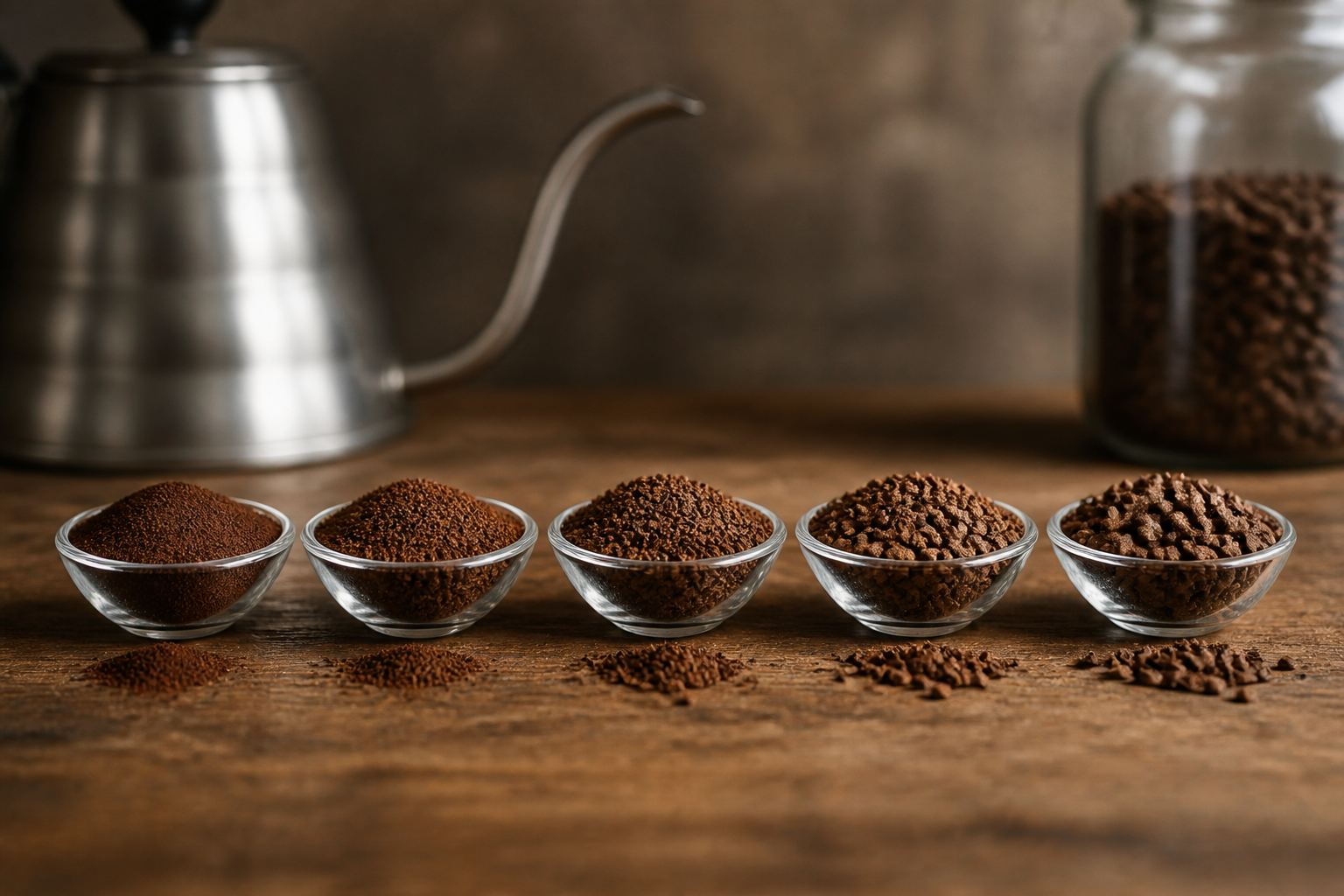
    A tall black electric burr grinder with a bean hopper and grind dial beside a short stainless blade grinder with a clear lid, both on a wooden counter

    A grinder’s uniformity is a measured width. It is how tightly the ground mass gathers around one particle size, and how much of it scatters into dust below that size and fragments above it. Particle size then sets how fast water empties each grain. In an extraction model of a brew that ends within minutes, the smallest grains come out close to spent while the largest are still giving up their centres.

    Particle sizes are set by an aperture in one grinder and by the clock in the other

    The burr grinder in a 2016 Scientific Reports study by Uman and colleagues fractures beans between two burrs, one stationary and one mobile. The team held the aperture between them constant for every coffee they measured, while bean origin and bean temperature varied. A blade grinder has one size control. It is the length of time the machine runs. Murray and Laredo, writing in the Journal of Food Research in 2015, describe beans cut “by means of a high speed turning blade”. That gives a distribution “usually broad and subject to variability based on somewhat arbitrary grinding time.”

    Advertisement

    Murray and Laredo then measured that spread in a household blade grinder. They ground 37-gram samples of whole beans for between 1.5 and 84 seconds. Each sample went through a stack of eight sieves, with openings from 9.5 millimetres down to 75 microns. Every fraction was then weighed. As grinding time grew, the distribution became “more narrow and asymmetric”. After 84 seconds most of the weighed sample sat between 75 and 300 microns, with 4% below 75 microns. That sieve record puts measured sizes on the chunks-and-dust picture of a blade grind. The spread was widest at the shortest grinding times, which leave the coarsest grinds, and narrowed as grinding drove the whole dose toward fine sizes.

    Uman’s group measured the burr side by laser diffraction. They ground coffees from four origins on a set of Turkish burrs, and found the surface-area profile “distinctly bimodal.” Two modes sit in that profile. They are near 27 microns for the fines, and near 257 to 282 microns for particles roughly ten times wider. By particle number, a tally the numerous fines dominate, 99% of that burr grind measured 70 microns across or less, and the fines carried “the majority of the accessible surface area.” Grinding the beans colder gave a narrower distribution and a smaller mean size. The two records come from different laboratories. They used different beans, and they tally particles differently: the laser profiles by number or by surface area, the sieves by weighed mass.

    A grain’s surface is emptied in seconds and a coarse grain’s core over minutes

    Water reaches the solubles in a coffee grain by two routes. A 2016 extraction model by Moroney and colleagues in the Journal of Mathematics in Industry names both. Extraction from a single grain, in their words, is controlled by two processes, “a rapid dissolution of coffee from the grain surfaces in conjunction with a much slower diffusion of coffee through the tortuous intragranular pore network to the grain surfaces.” The grains are treated as a dilute, well-mixed suspension, with parameters from the group’s experimentally validated 2015 paper. The model then gives each route a timescale.

    For a fine drip-filter grind the surface timescale is about 1.2 seconds and the diffusion timescale about 42 seconds. For a relatively coarse grind they are about 19 and 270 seconds. The coarse grind’s diffusion clock therefore runs about 6.4 times as long, and its surface clock about 16 times as long. In the model’s definitions each timescale grows with a Sauter mean diameter, the size of a sphere sharing the grains’ ratio of volume to surface, so a larger grain runs slower on both routes.

    In a wide distribution those clocks run side by side within a single brew. Uman’s group states the consequence plainly: “variable accessible surface area causes the small particles to extract more rapidly relative to larger ones.” Given long enough, the slow clock finishes too. Liang, Chan and Ristenpart, writing in Scientific Reports in 2021, ground coffee across a more than twofold range of median particle size, measured by laser diffraction. Each full-immersion brew stood until its dissolved solids held steady. That took 20 minutes at 99°C and 60 minutes at 80°C.

    At that equilibrium the extraction yield averaged 20.70 ± 1.08% at brew ratios of 3 and above, and “variation in brew temperature or grind sizes did not considerably alter” it. The same paper describes flow brewing as the case where “the flow rate, brew ratio, and total brew time can be varied.” Taking the well-mixed model’s clock as a guide to a percolation bed, a brew that drains in four and a half minutes has run for about one diffusion timescale of the coarser grind. Its coarse grains are then still giving up solubles from their cores when the water leaves.

    Flavour has been measured on brewed coffee, both as whole-cup averages and as time-sliced fractions. At the UC Davis Coffee Center, 12 panelists scored drip brews of one washed coffee from Honduras. Sourness rose with total dissolved solids, a measure of strength. It fell as percent extraction rose. Bitterness, charted for a medium roast, rose with both. Those findings come from the researchers’ own summary of their 2020 Journal of Food Science paper, published by the Specialty Coffee Association, an industry association. A trained panel from the same group also tasted drip brews collected in 30-second fractions. The earlier fractions, which carry more dissolved solids, were “systematically more bitter and more sour” than the later ones.

    Advertisement — advertiser disclosure

    A broad distribution is brewed as several extractions at once

    In a brew stopped short of equilibrium, the extraction kinetics put a broad grind’s fines further along than its largest fragments, inside one cup. A matched-yield tasting of a blade grind against a burr grind is the experiment that would score what that split does to flavour. The UC Davis whole-cup results for that one coffee had sourness falling as extraction rose. In a medium roast, bitterness rose as extraction rose. Mapped onto those results, the split points to bitterness from the fines and sourness from the largest fragments, at an average yield between them.

  • Grind Size Isn’t a Setting. It’s the First Thing to Check.

    Grind Size Isn’t a Setting. It’s the First Thing to Check.

    Grind size is not a dial setting. It is how long your brew method leaves water in contact with the grounds — and matching those two is what decides whether the cup tastes right.

    Key takeaways

    • Of the four things that shape a cup — bean, roast, water, grind — grind size does the most damage when it is off, and it is the one people check last.
    • Longer contact time wants a coarser grind: cold brew steeps 8 to 24 hours and takes the coarsest; espresso runs in under 30 seconds and takes the finest.
    • Sour, thin or weak means under-extracted. The fix is a finer grind, not more coffee.
    • Bitter, harsh or dry on the finish means over-extracted. The fix is a coarser grind.
    • A blade grinder makes dust and chunks in the same batch, so half the cup over-extracts while the other half under-extracts. No setting fixes a spread.
    • When you are not sure which way to move, start coarse. Walking a grind finer is easier than rescuing a bitter cup.
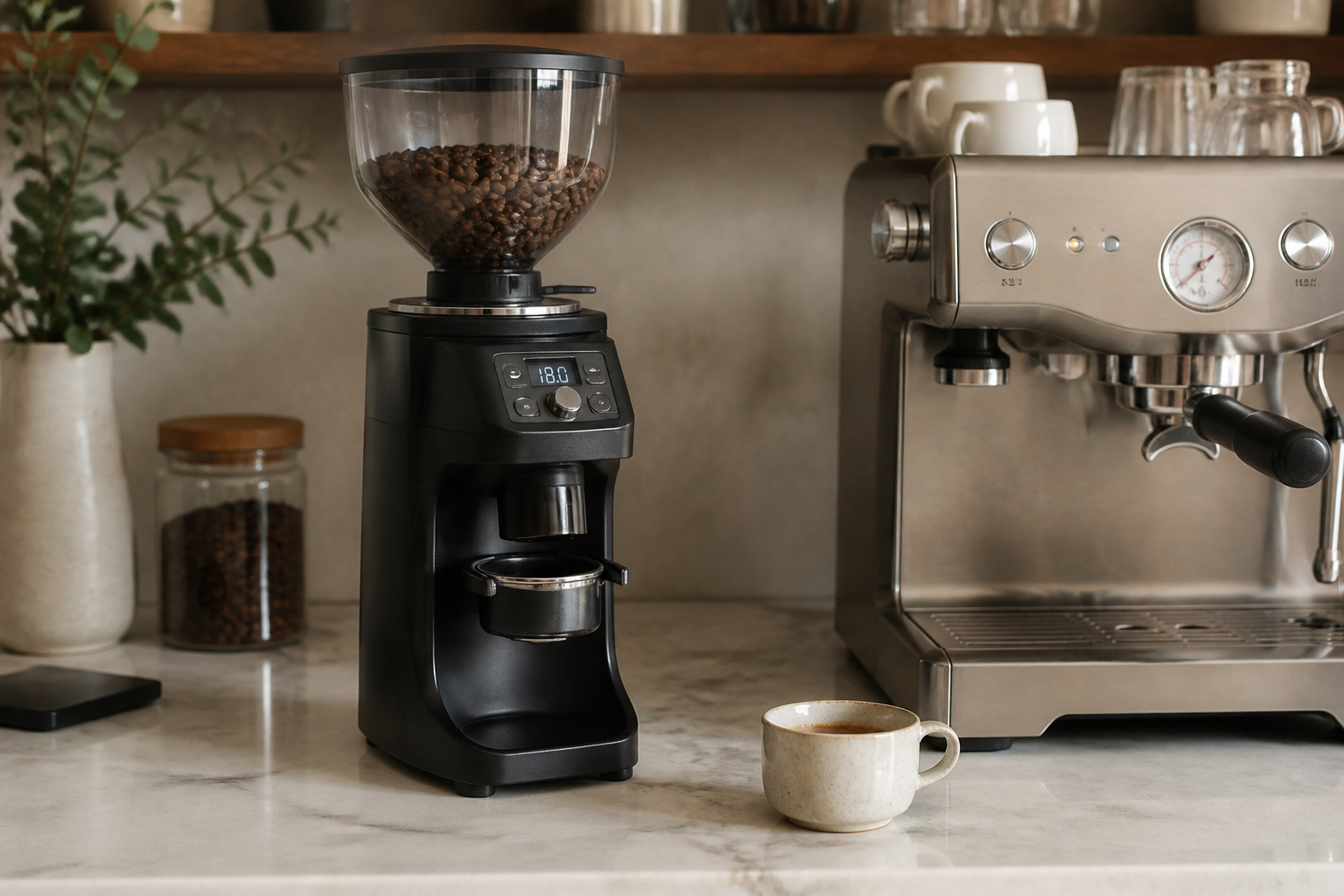
    Five small glass bowls in a row on a wooden counter, each holding coffee ground to a different size, from fine powder at the left to coarse chunks at the right, with a little of each spilled on the wood in front of it and a gooseneck kettle and a jar of beans out of focus behind

    Most people troubleshoot bad coffee backwards: better beans, then a better machine, then eventually a better grinder. Wrong order. Of the four things that actually shape your cup — bean, roast, water, grind — grind size does the most damage when it’s off, and it’s the one nobody checks first.

    Grind size isn’t really “fine” or “coarse” as abstract dial settings. It’s about how long your brew method leaves water in contact with the grounds. Longer contact time needs a coarser grind; shorter contact time needs a finer one. A French press holds water for several minutes. Espresso is done in under 30 seconds. Same beans, wildly different grinds.

    Two ways it goes wrong

    Too fine for the method, and you’re over-extracting. The water pulls out more than it should, and you get a harsh, bitter, ashtray note. Too coarse, and you’re under-extracting. Not enough gets pulled out, and you get a thin, weak, sour cup — no matter how much coffee you used. That second one trips people up constantly. “Weak” doesn’t mean “not enough coffee.” It means under-extraction, and the fix is a finer grind, not more grounds.

    Advertisement

    Why a blade grinder sabotages you even at the “right” setting

    This is the real case for a burr grinder over a blade grinder, and it’s mechanical, not snobbery. A blade grinder chops beans into a random spread of particle sizes — chunks and dust in the same batch. A burr grinder crushes beans between a fixed gap, producing one uniform size. Burr grinders come in two basic types, flat and conical. The type matters far less than the fact that it’s a burr at all.

    That uniformity is what lets water extract evenly. A blade grinder’s mixed particles don’t extract evenly: the dust over-extracts and turns bitter, while the chunks in the same cup are still under-extracted and sour. Both at once, in the same brew. Pulsing the blade grinder in short bursts knocks down the biggest chunks, but it doesn’t fix the real problem. You still get a wide spread of sizes, just a slightly narrower one. No single setting fixes that, because there isn’t one setting — there’s a spread.

    Grind size by method, at a glance

    The contact-time principle above turns into real settings once you match it to what’s actually brewing. Cold brew steeps for 8 to 24 hours, the longest contact time of any common method, so it wants the coarsest grind of the bunch. French press holds grounds for several minutes, typically 4 to 7 — still coarse, but less extreme. Drip machines and pour-over cones move water through faster than either immersion method, which calls for a medium grind. Espresso pushes water through in under 30 seconds. That’s the shortest contact time by far, and it needs the finest grind of any of them.

    These are starting points, not fixed settings. Your specific grinder, beans, and water still decide the exact dial.

    Advertisement — advertiser disclosure

    Dialing it in without a lab

    Taste the cup and let it tell you which way to move. Sour, thin, or weak → grind finer. Bitter, harsh, or dry on the finish → grind coarser. Adjust one step, brew again, taste again. If you’re not sure which way to start, err coarse. It’s easier to walk a grind finer over a few brews than to rescue an over-extracted, bitter cup. This is slower than following a settings chart, but it accounts for your actual water, beans, and grinder. Someone else’s number is only a starting point.

    The short version

    The grind comes first, and the grinder comes before that

    Grind size is the dial to adjust before you blame the beans, the water, or the machine. And if you’re still on a blade grinder, that upgrade moves the needle before any fancier gear does. Not because burr grinders are trendy — because inconsistent particle size makes even the “right” setting meaningless.

    Article sources

    1. Coffee preparation — Wikipedia (grind size/contact time relationship, over- and under-extraction definitions, uniformity, method-specific brew times)
    2. Barista Hustle — Coffee Extraction and How to Taste It (sour = under-extracted, bitter = over-extracted taste profiles)