In this piece
Grind size is not a dial setting. It is how long your brew method leaves water in contact with the grounds — and matching those two is what decides whether the cup tastes right.
Key takeaways
- Of the four things that shape a cup — bean, roast, water, grind — grind size does the most damage when it is off, and it is the one people check last.
- Longer contact time wants a coarser grind: cold brew steeps 8 to 24 hours and takes the coarsest; espresso runs in under 30 seconds and takes the finest.
- Sour, thin or weak means under-extracted. The fix is a finer grind, not more coffee.
- Bitter, harsh or dry on the finish means over-extracted. The fix is a coarser grind.
- A blade grinder makes dust and chunks in the same batch, so half the cup over-extracts while the other half under-extracts. No setting fixes a spread.
- When you are not sure which way to move, start coarse. Walking a grind finer is easier than rescuing a bitter cup.
Most people troubleshoot bad coffee backwards: better beans, then a better machine, then eventually a better grinder. Wrong order. Of the four things that actually shape your cup — bean, roast, water, grind — grind size does the most damage when it’s off, and it’s the one nobody checks first.
Grind size isn’t really “fine” or “coarse” as abstract dial settings. It’s about how long your brew method leaves water in contact with the grounds. Longer contact time needs a coarser grind; shorter contact time needs a finer one. A French press holds water for several minutes. Espresso is done in under 30 seconds. Same beans, wildly different grinds.
Two ways it goes wrong
Too fine for the method, and you’re over-extracting. The water pulls out more than it should, and you get a harsh, bitter, ashtray note. Too coarse, and you’re under-extracting. Not enough gets pulled out, and you get a thin, weak, sour cup — no matter how much coffee you used. That second one trips people up constantly. “Weak” doesn’t mean “not enough coffee.” It means under-extraction, and the fix is a finer grind, not more grounds.
Why a blade grinder sabotages you even at the “right” setting
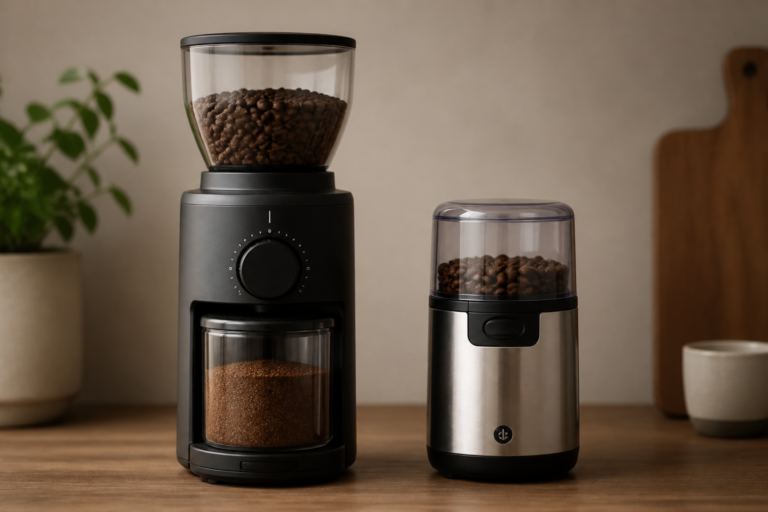
This is the real case for a burr grinder over a blade grinder, and it’s mechanical, not snobbery. A blade grinder chops beans into a random spread of particle sizes — chunks and dust in the same batch. A burr grinder crushes beans between a fixed gap, producing one uniform size. Burr grinders come in two basic types, flat and conical. The type matters far less than the fact that it’s a burr at all.
That uniformity is what lets water extract evenly. A blade grinder’s mixed particles don’t extract evenly: the dust over-extracts and turns bitter, while the chunks in the same cup are still under-extracted and sour. Both at once, in the same brew. Pulsing the blade grinder in short bursts knocks down the biggest chunks, but it doesn’t fix the real problem. You still get a wide spread of sizes, just a slightly narrower one. No single setting fixes that, because there isn’t one setting — there’s a spread.
Grind size by method, at a glance
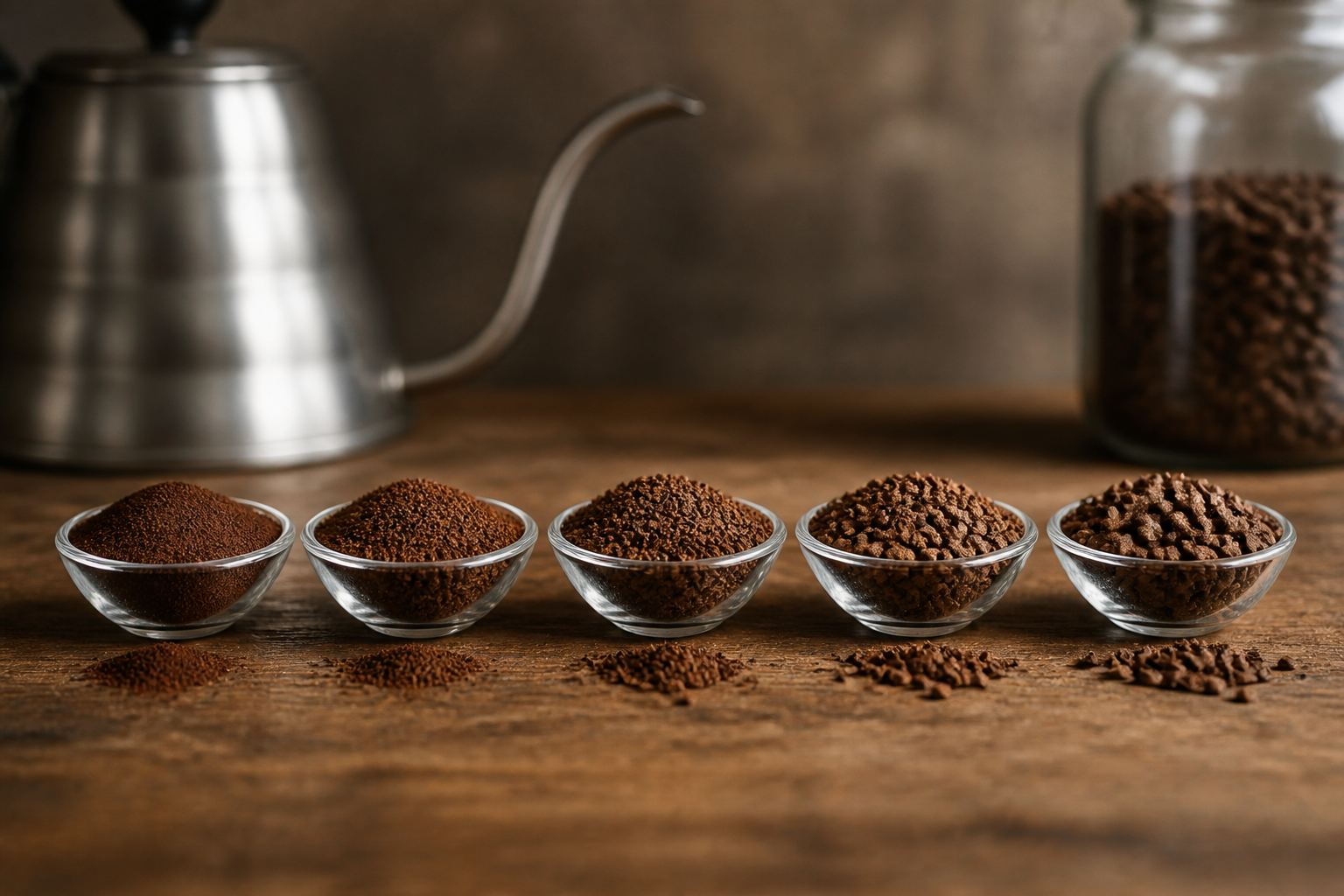
The contact-time principle above turns into real settings once you match it to what’s actually brewing. Cold brew steeps for 8 to 24 hours, the longest contact time of any common method, so it wants the coarsest grind of the bunch. French press holds grounds for several minutes, typically 4 to 7 — still coarse, but less extreme. Drip machines and pour-over cones move water through faster than either immersion method, which calls for a medium grind. Espresso pushes water through in under 30 seconds. That’s the shortest contact time by far, and it needs the finest grind of any of them.
These are starting points, not fixed settings. Your specific grinder, beans, and water still decide the exact dial.
Dialing it in without a lab
Taste the cup and let it tell you which way to move. Sour, thin, or weak → grind finer. Bitter, harsh, or dry on the finish → grind coarser. Adjust one step, brew again, taste again. If you’re not sure which way to start, err coarse. It’s easier to walk a grind finer over a few brews than to rescue an over-extracted, bitter cup. This is slower than following a settings chart, but it accounts for your actual water, beans, and grinder. Someone else’s number is only a starting point.
The short version
The grind comes first, and the grinder comes before that
Grind size is the dial to adjust before you blame the beans, the water, or the machine. And if you’re still on a blade grinder, that upgrade moves the needle before any fancier gear does. Not because burr grinders are trendy — because inconsistent particle size makes even the “right” setting meaningless.
Article sources
- Coffee preparation — Wikipedia (grind size/contact time relationship, over- and under-extraction definitions, uniformity, method-specific brew times)
- Barista Hustle — Coffee Extraction and How to Taste It (sour = under-extracted, bitter = over-extracted taste profiles)