In this piece
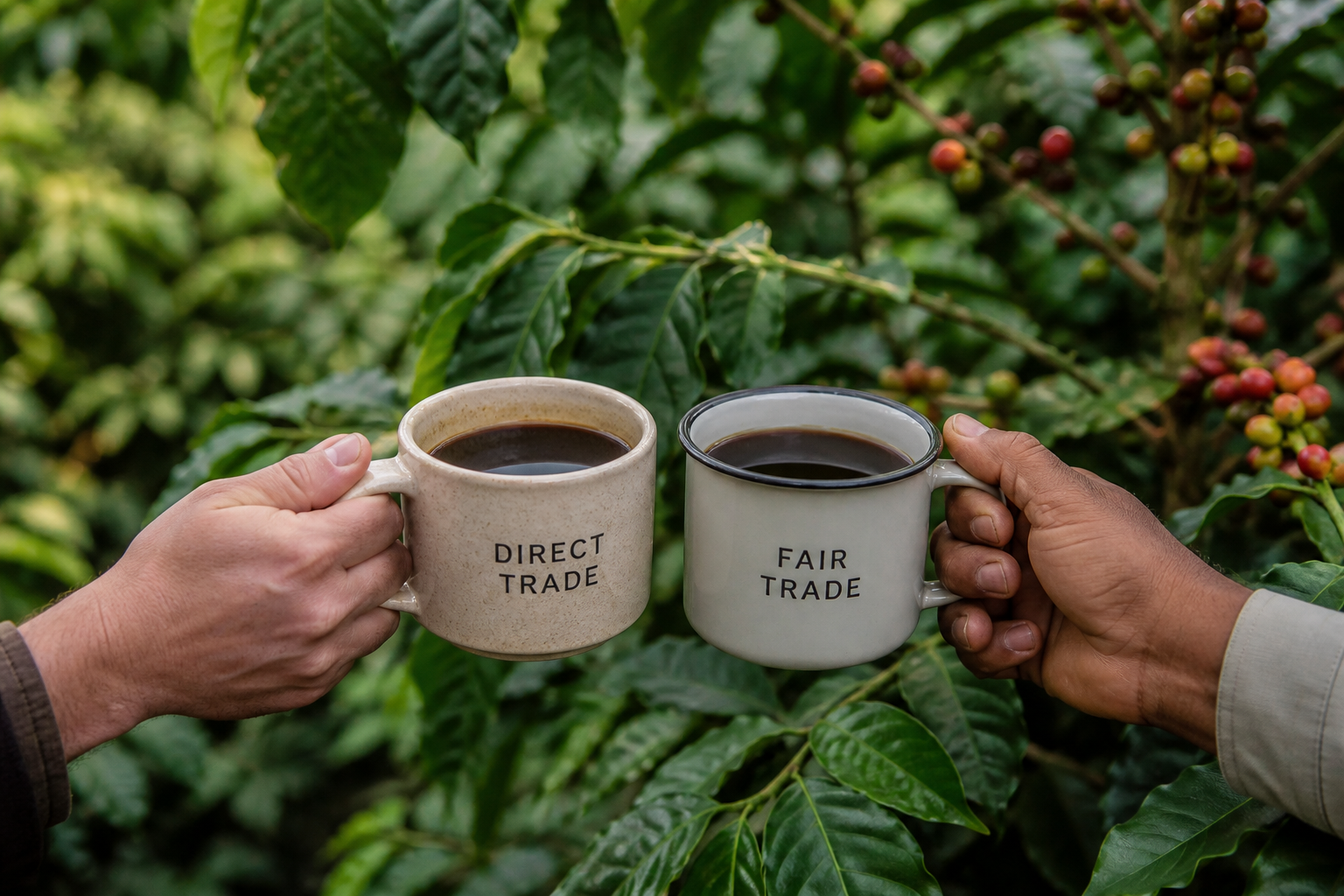
Two bags of coffee sit on a shelf. One says “Fair Trade Certified.” The other says “Direct Trade.” A shopper might assume these labels mean the same thing. Farmers got paid fairly, and someone checked. They don’t mean the same thing at all. One is a certification with a written standard, an independent auditor, and a published price floor. The other is a phrase a roaster can print on a bag with nobody checking a word of it. Knowing what each label leaves out matters more than most shoppers realize.
What Fair Trade Certification Guarantees
“Fair trade” isn’t one thing. It’s two separate certification systems, run by two different organizations, with two different price floors. Most bags don’t say which one applies. Fairtrade International, the Bonn-based group behind the original label, sets a minimum price. Farmer cooperatives must be paid that floor no matter how low the commodity market falls. For contracts signed on or after Dec. 1, 2026, that floor rises to $2.00 per pound for washed arabica, up from $1.80. A fixed $0.20-per-pound premium and a $0.40 organic differential come on top, according to the trade publication Daily Coffee News. Fair Trade USA is a separate organization. Its own history page dates the split from the international system to 2011, and, according to the certifier’s own coffee page, it runs its own standard: a guaranteed minimum of $1.40 per pound for washed arabica, plus a $0.20 social premium. Two certifiers, two different numbers, the same words on the bag.
Both systems require more than a price. Certification standards prohibit forced and child labor. They also require farmer organizations to meet business-capacity rules before they’re approved at all. But the premium doesn’t land directly in one farmer’s pocket. It’s paid to the cooperative instead, which votes on how to spend it – a warehouse, a cupping lab, a school, a loan fund. Advocates see that as the point: cooperatives make their own spending decisions, not a roaster. It also means the extra $0.20 a consumer imagines reaching one farmer’s hand more often becomes shared infrastructure.
Where Fair Trade Certification Falls Short
The most cited critique isn’t corruption. It’s a supply-and-demand mismatch. Fair trade coffee is a small share of the global specialty market. Cooperatives often grow more certified coffee than buyers want at the fair trade price. Research summarized in the Stanford Social Innovation Review, a Stanford-published magazine, found this creates a perverse incentive. Cooperatives route their lower-grade lots into the fair-trade channel, where the floor price applies regardless of cup quality. They sell their best beans on the open market instead, for more money. The certification doesn’t reliably signal quality in the cup. Whether it raises farmer income overall is a separate, genuinely contested question among agricultural economists – not a settled one.
Direct Trade Coffee Meaning — And What It Doesn’t Guarantee
“Direct trade” emerged in the 2000s as specialty roasters’ answer to fair trade’s limits. The idea: buy straight from a farm or mill, skip the middlemen, pay for cup quality instead of a commodity floor. Here’s the catch. Direct trade coffee has no legal definition. There’s no certifying body, no published standard, no third-party audit. The trade publication Perfect Daily Grind reported that the phrase “has no formal definition or certification.” Traders and roasters, it found, don’t necessarily have to substantiate that they bought coffee directly from farmers.
That doesn’t make direct trade meaningless. Some roasters maintain real, multi-year relationships with individual farms. They pay well above any certification floor and publish the prices to prove it. But nothing stops a roaster from printing “Direct Trade” on a bag sourced through a conventional exporter, with no farm relationship at all. That’s exactly why trade press treats the phrase as marketing language first, a sourcing model second. It only earns the second label when a roaster backs it with an actual price and an actual name at origin.
Direct Trade vs. Fair Trade Coffee: A Side-by-Side Comparison
A short comparison, stripped of marketing copy:
Written standard: Fairtrade International and Fair Trade USA both publish detailed rules. Direct trade has none.
Third-party audit: Both fair trade certifiers use independent auditors. Direct trade relies on the roaster’s word.
Minimum price: Fairtrade International guarantees $2.00/lb for washed arabica, for contracts signed on or after Dec. 1, 2026. Fair Trade USA guarantees $1.40/lb. Direct trade has no floor at all – it can pay more, or less, than either.
Cup quality: Neither fair trade system grades for quality. Direct trade often correlates with higher quality, since roasters hand-pick lots. Correlation isn’t a guarantee, though.
Where the money goes: Fair trade premiums go to the cooperative, which decides collectively. Direct trade payments usually go straight to the farm or mill owner. That can mean more money for that individual grower – or less for workers who aren’t owners.
What This Means for the Cup You’re Buying
Neither label is a shortcut to an ethical purchase. Neither is a scam, either. Fair trade certification buys a verified price floor and real labor protections. The cost: a system that doesn’t guarantee quality, and doesn’t always turn into higher farmer income once cooperative overhead is counted. Direct trade buys the possibility of a genuine relationship and real transparency. That only holds when the roaster actually practices what the word implies, and discloses what it paid. The only way to know which you’re getting is to ask a plain question: what price did the roaster pay, and can they show it? A bag that answers that honestly, certified or not, does more than any label on its own.
Article sources
- Fairtrade International Raises Price Minimums Again — Daily Coffee News
- Fair Trade Coffee Innovation — Fair Trade USA
- The Problem With Fair Trade Coffee — Stanford Social Innovation Review
- Maximising Coffee’s Impact: Why Retaining Value at Origin Through Direct Trade — Perfect Daily Grind
- Our History — Fair Trade USA