In this piece
Water is about 98% of a cup of coffee and the solvent doing the extraction — its mineral content decides how much flavour comes out of the grounds, and which flavours those are.
Key takeaways
- Water is roughly 98% of the cup. It is the solvent, not the background.
- Too hard, and extraction saturates early: the cup lands flat and often bitter.
- Too soft, and there is nothing for flavour compounds to bond with: the cup lands thin however long you brew.
- Calcium binds the heavier notes — chocolate, caramel. Magnesium binds the bright ones — florals, citrus. A good cup needs both.
- The SCA targets: TDS around 150 mg/L, hardness roughly 51–68 mg/L, alkalinity around 40 mg/L, pH 6.5–7.5.
- A $15 TDS meter tells you which direction to fix before you spend anything on gear.
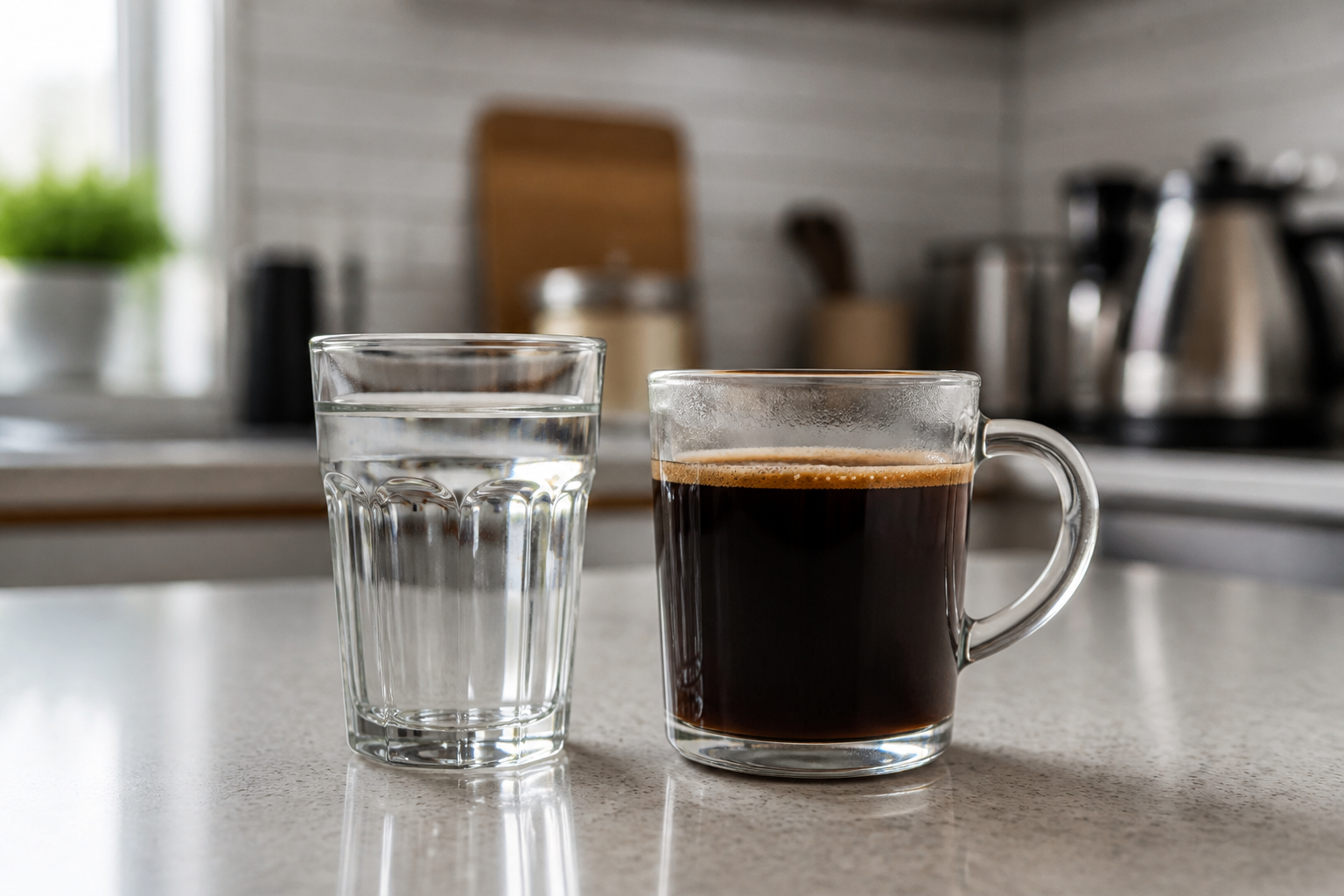
Same beans. Same grind size. Same brewer, even, if you bought the exact model your favorite café uses. And the coffee still tastes flatter, or thinner, or just off. Before you blame your technique, check something most people never think about: your water.
Water makes up about 98% of a cup of coffee. It isn’t a neutral background ingredient. It’s the actual solvent doing the extraction. Its mineral content changes what comes out of the grounds, and how the result tastes.
Hard water and soft water pull different things out of the same beans
“Hard” water carries more dissolved calcium and magnesium. “Soft” water carries less. Both extremes cause real problems, just in opposite directions.
Water that’s too hard extracts fast and stops early. It’s already carrying so many minerals that it saturates quickly. It grabs flavor compounds early, then quits. The result is a flat, often bitter cup that undersells the beans. This shows up a lot in places with naturally mineral-heavy tap water. Parts of the Midwest and Texas are common examples.
Water that’s too soft has the opposite problem. Distilled water, or water run through an aggressive home softener, has almost nothing in it to bond with flavor compounds. Extraction stays weak no matter how long you brew. You end up with something thin and watery, even from great beans and a careful brew.
The two minerals doing the real work
Calcium and magnesium aren’t interchangeable. They tend to grab different things.
Calcium binds more with heavier, rounder flavor compounds — think chocolate, caramel, brown sugar. Magnesium binds more with brighter aromatics — florals, citrus, berry notes. A healthy mix of both tends to produce a cup with real depth and real brightness. Lean too hard on one mineral, and you lose the other side of that balance.
The four numbers that matter
The Specialty Coffee Association publishes a water quality standard for brewing, built around a handful of measurable targets:
- Total dissolved solids (TDS): target around 150 mg/L, acceptable range roughly 75–250 mg/L.
- Calcium/magnesium hardness: ideal range roughly 51–68 mg/L (about 3–4 grains per gallon).
- Total alkalinity: around 40 mg/L.
- pH: between 6.5 and 7.5, with 7.0 as the target.
Sodium and chlorine matter too, mostly by their absence. Chlorine especially should be filtered out entirely — it shows up directly as an off-flavor, no mineral balance can fix.
You don’t need to hit these numbers exactly. Cafés chasing competition-level consistency care about precision. A home brewer mostly just needs to land in the right neighborhood.
You don’t need a lab to check water quality
Two practical options cover almost everyone.
A cheap TDS meter, around $15, tells you roughly where your tap water sits. That’s often enough to diagnose “too hard” versus “too soft,” without much further guesswork.
Pre-mixed brewing water, sold specifically to hit the SCA targets, is the simplest fix for a known problem — hard well water, an aggressive softener, or a chlorine-heavy municipal supply. It costs more than tap water. It costs far less than another bag of good beans brewed badly, over and over, without knowing why.
If you’re on a municipal supply and don’t know your water’s mineral content, check first. Most utilities publish an annual water quality report online. It’s worth five minutes, before you spend real money chasing a “better” grinder that was never the actual problem.
A quick gut-check before you buy anything
Notice where the coffee tastes off. Flat and a little bitter, even with a fresh light roast, points toward water that’s too hard. Thin and watery, even with a slow, careful pour, points toward water that’s too soft. That alone is often enough to know which direction to fix, before a single test strip.
The short version
Rule out the water before you re-dial anything
Grind size and brew ratio get most of the attention, and they matter. But both are working through your water, not around it. If a dialed-in recipe still tastes wrong, or the same beans taste better somewhere else, rule out the water first. It’s usually the faster fix, and often the real answer.
Article sources
- Pulled Journal — Coffee Brewing Water: TDS, Hardness, and the Cheap Fixes That Work (SCA target/range figures, calcium vs. magnesium flavor-binding explanation, hard/soft water extraction effects)
- 43 Factory Coffee — Dissecting SCAA’s Water Quality Standard (cross-check on SCA TDS, hardness, alkalinity, pH, and sodium figures)
- Third Wave Water — What Is SCA Water Standard? (cross-check on the same standard, chlorine/clarity requirements)