Bills & Beans

Straight Talk on Coffee, Money, and Liberty

Tag: The Real Cost

  • Paying the Minimum on a Credit Card: What It Costs Over the Life of the Balance

    Paying the Minimum on a Credit Card: What It Costs Over the Life of the Balance

    Two hands filling in a blank payment slip headed Monthly Payment beside an unmarked payment card and a mug of black coffee

    What does paying only the minimum cost on a $5,000 credit card balance at 22.15%, the Federal Reserve’s second-quarter 2026 rate for commercial-bank card accounts assessed interest? Under a minimum of 1% of the balance plus interest, with a $40 floor and nothing new charged, it takes 182 payments totalling $12,395.77, and $7,395.77 of that is interest.

    How 1% plus interest sets the first payment at $143.21

    Card issuers set their own minimum payment formulas, and 20 of 21 surveyed issuers describe theirs in publicly available agreements, according to the Consumer Financial Protection Bureau’s December 2025 report to Congress on the card market. The Bureau found that minimum payment policies “can vary across issuers and across card products by the same issuer.” Among the issuers in its agreement review, most set the percentage at 1 percent of the balance and typically added finance charges and fees on top. The most common dollar floor at the time of that 2025 review was $40, up $15 since 2015.

    I built the formula for this case from those most common terms, which makes it an assumption. Each month the minimum is the greater of $40 or 1% of the statement balance plus that month’s interest, capped at whatever is owed. I set the starting balance at a round $5,000 for the example, and nothing new goes on the card for the whole run. The rate is 22.15%, the second-quarter 2026 figure for commercial banks on card accounts assessed interest in the Federal Reserve’s G.19 release of September 8, 2026, where the quarter is marked revised. Divided by twelve, with the rate held fixed and no fees added, 22.15% brings $92.29 of interest in month 1 and a statement balance of $5,092.29. The minimum is 1% of that statement, $50.92, plus the $92.29 of interest, for a first payment of $143.21.

    Advertisement

    Why 125 straight payments go about 64% to interest

    Because the formula passes each month’s interest through in full and adds 1% of the balance on top, the split of every formula payment depends on the rate alone. At 22.15%, about 64 cents of each dollar paid goes to interest, and the share holds there from month 1 through month 125. The principal portion falls with the balance, from $50.92 in month 1 to $45.50 in month 12. The balance therefore shrinks by about 1.02% of itself each month, and it first drops below half, to $2,492.65, in month 68.

    The minimum shrinks by the same 1.02% a month, and that shared shrinkage is what flattens the payoff curve. The payment falls below $100 in month 37 and reaches $72.13 in month 68, roughly half the first payment. By month 120 the minimum is $42.36, and ten years of payments have sent $6,408.99 to interest against $3,536.21 of principal.

    MonthBalance before interestInterest chargedMinimum paidBalance after paymentInterest paid to date
    1$5,000.00$92.29$143.21$4,949.08$92.29
    12$4,467.53$82.46$127.96$4,422.03$1,047.51
    37$3,458.79$63.84$99.07$3,423.56$2,857.13
    68$2,518.30$46.48$72.13$2,492.65$4,544.31
    120$1,478.85$27.30$42.36$1,463.79$6,408.99
    125$1,405.05$25.93$40.24$1,390.74$6,541.35
    126$1,390.74$25.67$40.00$1,376.41$6,567.02
    150$962.91$17.77$40.00$940.68$7,091.29
    170$431.11$7.96$40.00$399.07$7,349.68
    181$44.25$0.82$40.00$5.07$7,395.68
    182$5.07$0.09$5.16$0.00$7,395.77
    Starting balance of $5,000 set for the example. APR 22.15%: Federal Reserve G.19 (September 8, 2026 release), commercial banks, credit card accounts assessed interest, 2026 Q2, held fixed for all 182 months. Monthly interest at APR/12 on the balance, rounded to the cent. Minimum: the greater of $40 or 1% of the statement balance plus that month’s interest, capped at the statement balance. No new charges, no fees. Months 1-125 use the 1% formula; from month 126 the $40 floor applies until the capped final payment.

    Advertisement

    Where the $40 floor takes over for the last 57 payments

    In month 126 the formula produces $39.83, so the $40 floor binds for the first time, on an opening balance of $1,390.74. By then, ten years and five months of payments have retired $3,609.26 of the original $5,000. From then on the payment holds still while the interest keeps falling, so a larger slice of each $40 goes to principal every month. The interest share of the payment slides from 64.2% in month 126 to 19.9% by month 170.

    The tail runs 57 payments and adds $854.42 of interest, about 12% of the whole interest bill. It ends in month 182, fifteen years and one month after the first statement, with a final payment of $5.16 that clears the last $5.07 of principal and nine cents of interest.

    The short version

    What the repayment disclosures would print for this balance

    Across 182 payments the card collected $12,395.77, which works out to about $1.48 of interest for every dollar originally borrowed. The first statement built on this formula would print the repayment estimate as 15 years, because Regulation Z’s periodic statement rule states any estimate of two years or more in whole years. Since 15 years runs past three years and the 36-month payment of $191.34 exceeds the $143.21 minimum, the disclosure must also print that payment and its total cost, $6,888.24 to the cent.

    The schedule follows one minimum payment formula built for this example; your issuer’s own formula is set out in your cardholder agreement or on your statement, and the repayment estimate on your monthly statement, where one appears, is the figure for your account.

  • Cost Per Cup: Home Brewing vs. Café, With the Gear Counted

    Cost Per Cup: Home Brewing vs. Café, With the Gear Counted

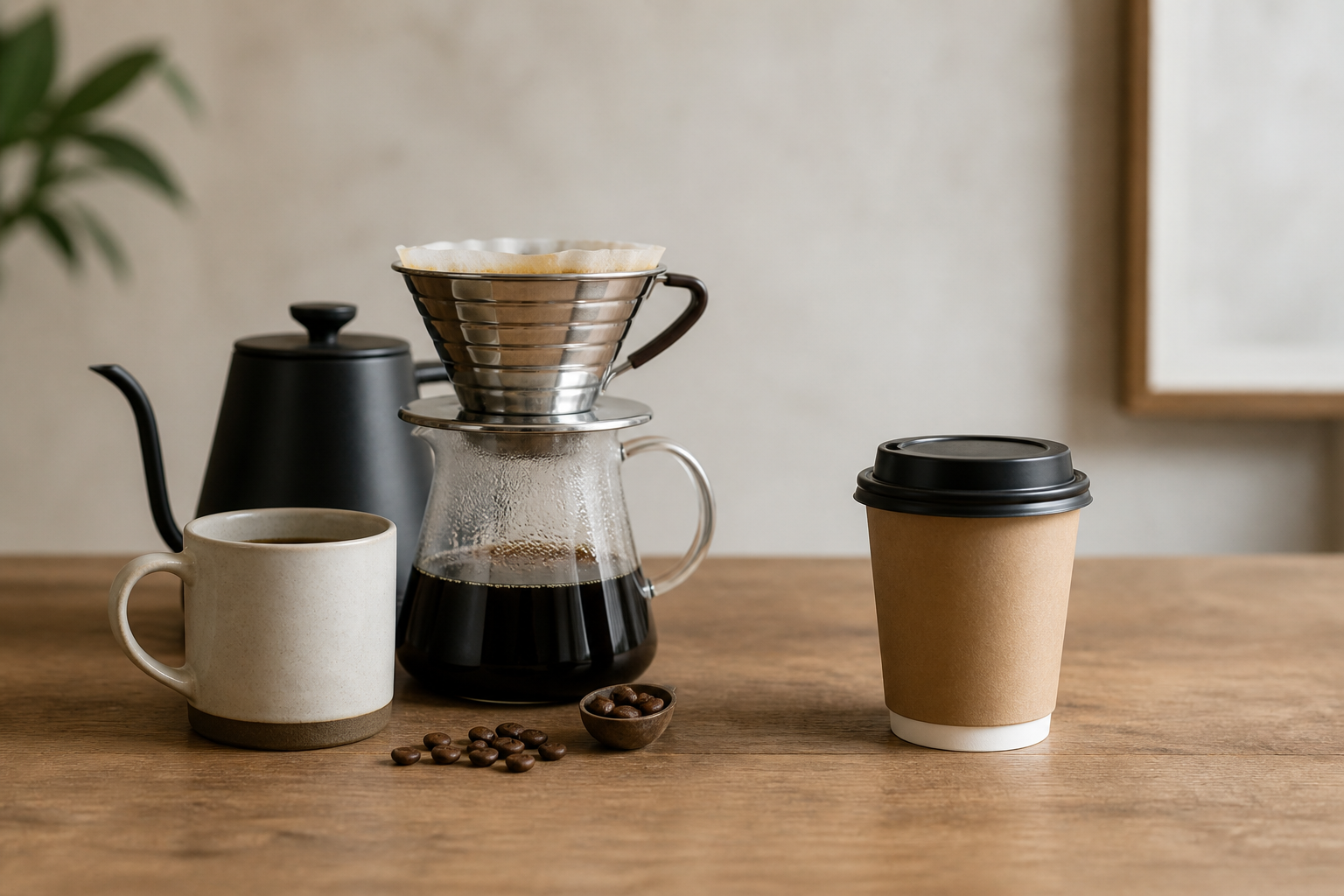
    A home pour-over set-up with kettle, carafe and mug on a wooden table at the left, and a lidded takeaway cup from a cafe at the right

    Coffee has several published prices, each measuring something different. A cost per cup gets assembled from three of them, plus a number nobody publishes at all. That last one is why the honest output here is a break-even counted in cups.

    The price of coffee is at least three different published series

    Start with the beans. The Bureau of Labor Statistics priced ground roast coffee at $9.317 per pound in July 2026, U.S. city average, not seasonally adjusted. That series covers supermarket ground coffee, all sizes. It is the broadest and cheapest tier on the shelf. It went out with the July CPI release on 12 August 2026.

    Advertisement

    The café side has no federal equivalent. BLS publishes no menu price for a hot coffee, so the comparison has to leave the government series behind. Toast, a restaurant point-of-sale vendor, puts the median at $3.77 for a regular hot coffee in July 2026. That is up 7.4% on July 2025. The figure is a payments vendor’s own published median, drawn from the menus of restaurants on its platform. It is the best number available for the job, and it does not carry the standing a federal series does.

    The third publisher supplies no price at all. SCA Standard 310-2021 fixes a brew ratio of 55 g of coffee per 1.000 kg of water. The Specialty Coffee Association wrote it. That URL is a public verbatim mirror, because the association’s own copy sits behind membership. The ratio is a test ratio, written to make brewers comparable under controlled conditions rather than as a recipe for your kitchen.

    A pound of supermarket ground makes about 23 defined cups

    Set the cup at 350 g of brewing water, a little under a 12-ounce mug. At the test ratio that draws 19.25 g of coffee. A pound is 453.6 g, so a pound yields about 23 cups. Call it a defined cup: the size the standard implies, not the size of your mug.

    At $9.317 a pound, 19.25 g of beans costs 39.5 cents. Those same 23 cups bought across a café counter at the median come to $86.71. The remaining lines cannot close that gap. They can still move the break-even.

    Electricity lands under a penny; the gear line is where the money sits

    The EIA puts the residential electricity price at 18.34 cents per kilowatthour for June 2026, released 26 August 2026. EIA is candid about the method. It calculates average retail revenue per kWh as a proxy for rates, because it does not collect retail rates directly. Assume, illustratively, 0.04 kWh to boil and brew one 350 g cup. That is seven tenths of a cent.

    Gear is the line that moves the answer, and it is the line nobody publishes. No national average exists for what a household spends on a brewer and a grinder. Inventing one would be worse than admitting the hole. So state the assumptions and divide.

    An illustrative $240 of equipment over an illustrative 4,000-cup life comes to six cents a cup. Four thousand cups is two a day for about five and a half years. Substitute your own two numbers; the method is the durable part. Purchase price divided by the cups it will make before it dies is the whole of it. The case that the grinder is the first upgrade worth making of it is argued elsewhere on this site.

    LineCost per cupFigure behind itSourceSource period
    Beans, 19.25 g at the test ratio$0.395$9.317 per lb, ground roast, all sizesBLS Average Price Data, series APU0000717311July 2026
    Electricity — ILLUSTRATIVE energy use$0.0070.04 kWh (illustrative) at 18.34 cents/kWh (published)EIA Electricity Monthly UpdateJune 2026 data
    Gear amortisation — ILLUSTRATIVE$0.060$240 over 4,000 cups, both figures assumedassumption, no published series existsn/a
    Home cup, total$0.462sum of the three lines abovemixed, incl. ILLUSTRATIVE rowsn/a
    Café, one regular hot coffee$3.770median menu price on one vendor’s platformToast, Inc. Menu Price MonitorJuly 2026
    Difference per cup$3.308café median less home total, which includes ILLUSTRATIVE rowsderivedn/a
    Beans: U.S. Bureau of Labor Statistics, Average Price Data series APU0000717311, “Coffee, 100%, ground roast, all sizes, per lb. (453.6 gm), U.S. city average, not seasonally adjusted”, July 2026, published with the CPI release of 12 August 2026 and retrieved from the BLS public data API on 8 September 2026. Café: Toast, Inc. Menu Price Monitor, a point-of-sale vendor’s own published median drawn from its platform’s menus, published 11 August 2026, fetched 8 September 2026. Electricity price: U.S. Energy Information Administration, Electricity Monthly Update, June 2026 data, released 26 August 2026. Cup defined as 350 g of water at the 55 g per 1.000 kg test ratio in SCA Standard 310-2021. Rows marked ILLUSTRATIVE use assumed figures chosen to demonstrate the method; they are not published data and should be replaced with your own.

    Seventy-two cups repays the illustrative gear budget

    Once the gear is bought, it is spent. What governs the decision afterwards is the marginal cup: beans plus electricity, 40.3 cents. Against a $3.77 median that saves $3.37 every time. So $240 of illustrative gear repays itself in 72 cups, which is about five weeks at two cups a day.

    Now run it on a specialty bag. Assume double the BLS per-pound price — an assumption, since no published series tracks specialty retail this way. The bean line goes to 79 cents and the marginal cup to 79.8 cents. The saving falls to $2.97 and the break-even moves to 81 cups, roughly six weeks. Doubling the bean price barely dents the payback period, because the café median is so far above both.

    Advertisement — advertiser disclosure

    The café is also selling labour, rent and a chair

    The table prices inputs. A café prices inputs plus a barista’s hour, a lease, a service contract, and somewhere to sit. Subtracting one from the other measures one thing and implies another. A piece that skips that is doing sleight of hand.

    There is a quality axis too, and it does not run parallel to the cost axis. Water treatment, grinder consistency and a machine that holds its temperature are part of what $3.77 buys. Why your coffee tastes different at home than at the café takes the same comparison down that side of it.

    The table also omits consumables it cannot source. Paper filters and tap water have no published per-cup series behind them. They are small. They are not zero, and treating a table as complete because it adds up is how this genre goes wrong.

    The short version

    Swap the two assumed lines and the break-even moves; the gap does not close

    The gear line and the electricity line are assumptions, labelled as assumptions, because nothing published covers them. Swap in your own and the break-even in cups moves with them, up if the kit cost more and down if it cost less. What does not move is the distance between forty-odd cents and $3.77, because that distance is set by two published series and neither of them is your equipment. Both series move month to month, so re-read them before trusting the number.

  • The Grinder Comes First: How to Spend a Coffee Budget in the Right Order

    The Grinder Comes First: How to Spend a Coffee Budget in the Right Order

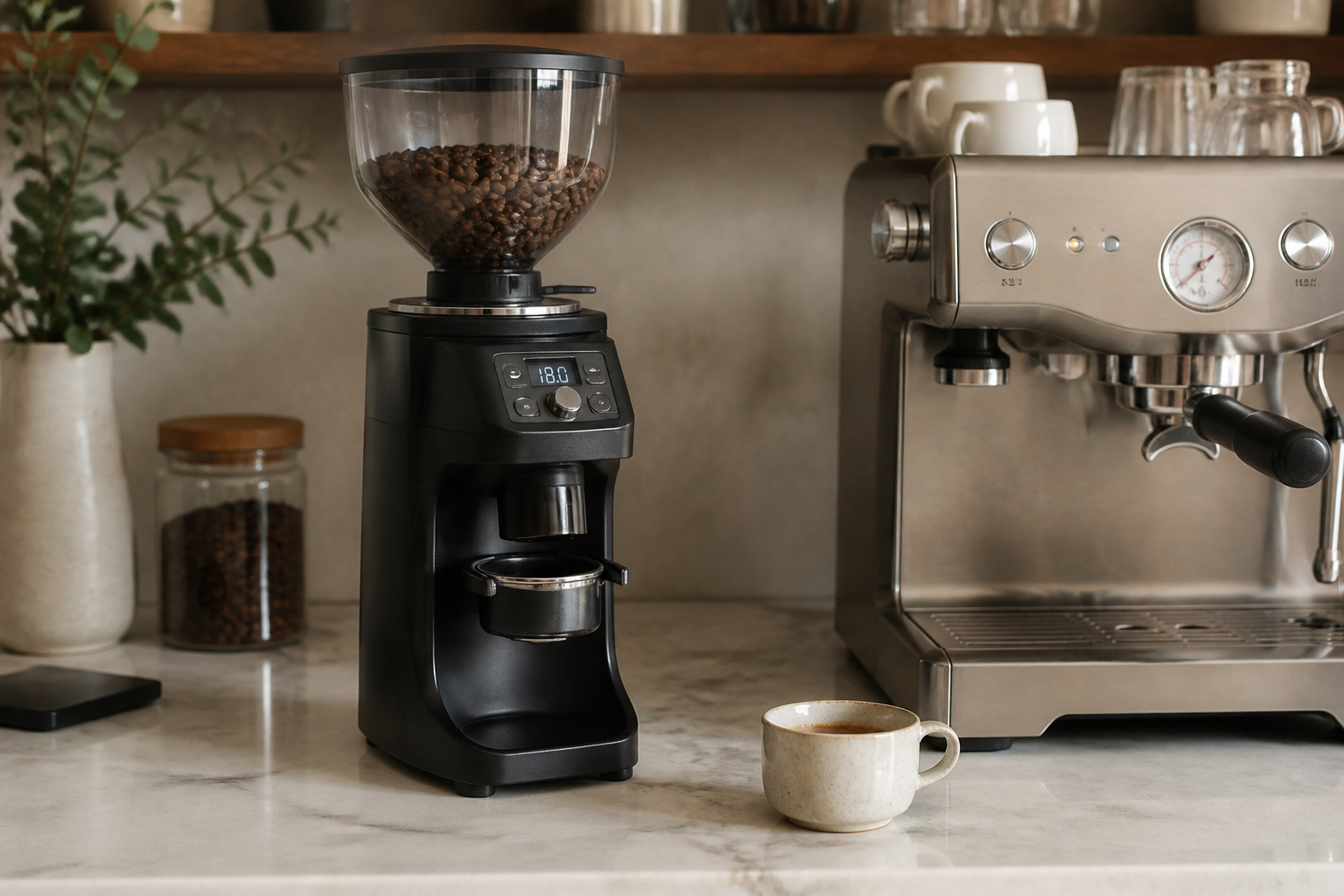
    A black electric burr grinder full of beans in the foreground of a marble counter, a stainless espresso machine out of focus behind it

    Whatever else a setup has on it, one purchase decides the spread of particle sizes the water works through. A certification standard for home electric filter brewers puts that spread in three bands at once — under 12% above 850 microns, at least 68% between 425 and 850, no more than 20% below — and nothing bought later moves it.

    Three bands of particle size, from a single machine

    The first purchase has more to work with than the second, and the reason is mechanical. SCA Standard 310-2021 sets the test grind as a distribution, not a setting. For a conical brew basket, under 12% of the grounds by mass may sit above 850 microns. At least 68% must fall between 425 and 850, and 20% or less below 425. The standard covers electric filter brewers designed for home use. Pour-over devices, French press, home espresso machines and pod brewers are excluded from it by name. The Specialty Coffee Association, an industry association, wrote the standard. The copy that loads is a public verbatim mirror, because the association’s own link returns a 404 and its standards page lists the document as member-only.

    Advertisement

    Three constraints held at once is a specification for a machine. Burr geometry and motor speed decide how much of a dose lands in each band. That is why the same dose leaves two grinders distributed differently.

    Calcium hardness inside a 50-to-175 ppm window

    The same standard says what the water has to be before any of this gets tested: odor-free, free of chlorine, calcium hardness equivalent to 50 to 175 ppm as calcium carbonate, alkalinity 40 to 70 ppm, and pH between 6 and 8. The provenance caveat repeats, because this is the same member-only document read from the same public mirror. It is a condition of a laboratory test, not a promise about flavor. Water sets what the brew can dissolve. What the water is already carrying when it meets the grounds decides how much of that room is left.

    Contact geometry and time, with the grind as the adjustment

    A brewer governs temperature history and bed shape. The standard requires the slurry to reach 90 to 96°C. It has to be there by the moment 33% of the water has been sprayed onto the coffee. Then it holds that range for the rest of the cycle. Narrow, and checkable. Then watch the test procedure when a brewer misses its targets. It adjusts the grind, within the three bands above, and runs the test again. The document treats the brewer as the fixed thing and the grind as the variable one. That is a buying order, written into a test method by people with no stake in anybody’s budget.

    Scales, kettles and the rest, bought for repeatability rather than extraction

    Past the brewer, the money buys measurement. A scale holds the standard brew ratio — 55 g of coffee per 1.000 kg of water — at the same figure every morning. That is worth doing. It is not the same act as changing the cup.

    The standard and the study answer different questions, and both deserve naming. The association fixes a three-band particle spec as a control variable — its own words are that the distribution is “chosen to systematize the testing process” — and sets no extraction-yield target at all. A 2021 paper in the peer-reviewed journal Scientific Reports, whose senior author sat on the standard’s expert group, measured full immersion brews at equilibrium and reported extraction yield near 21%. The spread was about 19 to 23%, across median particle sizes from 580 to 1,310 microns — a 730-micron span. Finer grounds did extract more. The effect was small enough that the authors name brew ratio, not grind, as the parameter to watch.

    Scope decides which one applies. That study measures immersion at equilibrium; a drip brewer passes its water through the bed once. The standard’s own conditions of household use assume at least 65% of the grounds between 589 and 1,168 microns.

    The bean line, up 10.7% in twelve months

    One line in this chain recurs, and no purchase controls it. The Bureau of Labor Statistics priced ground roast coffee at $9.317 a pound in July 2026, a U.S. city average, not seasonally adjusted. The same series read $8.414 in July 2025, which makes the twelve-month rise 10.7%. The series covers 100% ground roast coffee, all sizes. Equipment gets bought once and argued about afterwards. The beans get bought again on Saturday.

    Advertisement — advertiser disclosure

    Five purchases, each against its own limit

    Purchase, in orderWhat it governs, and the published figureWhat it does not govern, at any price
    GrinderParticle size distribution: ≤12% by mass above 850 µm, ≥68% between 425–850 µm, ≤20% below 425 µm (SCA 310-2021, conical basket)Extraction yield at equilibrium in full immersion — a 580–1,310 µm span of median size moved it by no more than about four points, 19–23%, around a ceiling near 21%
    WaterWhat the brew may dissolve: calcium hardness 50–175 ppm CaCO₃, alkalinity 40–70 ppm CaCO₃, pH 6–8, odor-free and chlorine-free (SCA 310-2021)Slurry temperature, which the same standard assigns to the brewer at 90–96°C
    BrewerContact geometry and temperature history: slurry at 90–96°C by the moment 33% of the water is sprayed, held for the rest of the cycle (SCA 310-2021)The grind — the standard’s test adjusts the grind to the brewer, never the brewer to the grind
    Scale and kettleRepeatability of the standard brew ratio, 55 g of coffee per 1.000 kg of water (SCA 310-2021)Extraction yield: ratio moves brew strength, and in full immersion leaves yield near 21%
    Beans (recurring)The only recurring line: $9.317 per lb, July 2026, ground roast, all sizes (BLS APU0000717311)Distribution, dissolved load or temperature — a bean price moves none of them; the line simply repeats, up 10.7% from $8.414 in July 2025

    Every figure in that table is from SCA Standard 310-2021, the Scientific Reports paper or BLS series APU0000717311.

    This ordering assumes an electric filter brewer at household scale, the only kind the standard covers, and water that arrives drinkable. It says nothing about hand grinders bought in place of electric ones, nothing about used equipment, and nothing about a supply that needs treating first. It also assumes somebody intends to taste the difference. That is a claim about a person, not a machine.

    The short version

    The full-immersion ceiling near 21%, past the reach of the next purchase

    Full immersion has an extraction ceiling, and money reaches it early. In the immersion measurements above it sits near 21%. A 730-micron span of grind moved it by no more than about four percentage points. So spend where a component still governs something no other component can reach. The distribution first, then what the water can dissolve, then the temperature and the bed. After that the purchases buy repeatability, which is worth owning as long as nobody sells it as flavor.

  • Direct Trade vs. Fair Trade Coffee and the Promise Each Label Makes

    Direct Trade vs. Fair Trade Coffee and the Promise Each Label Makes

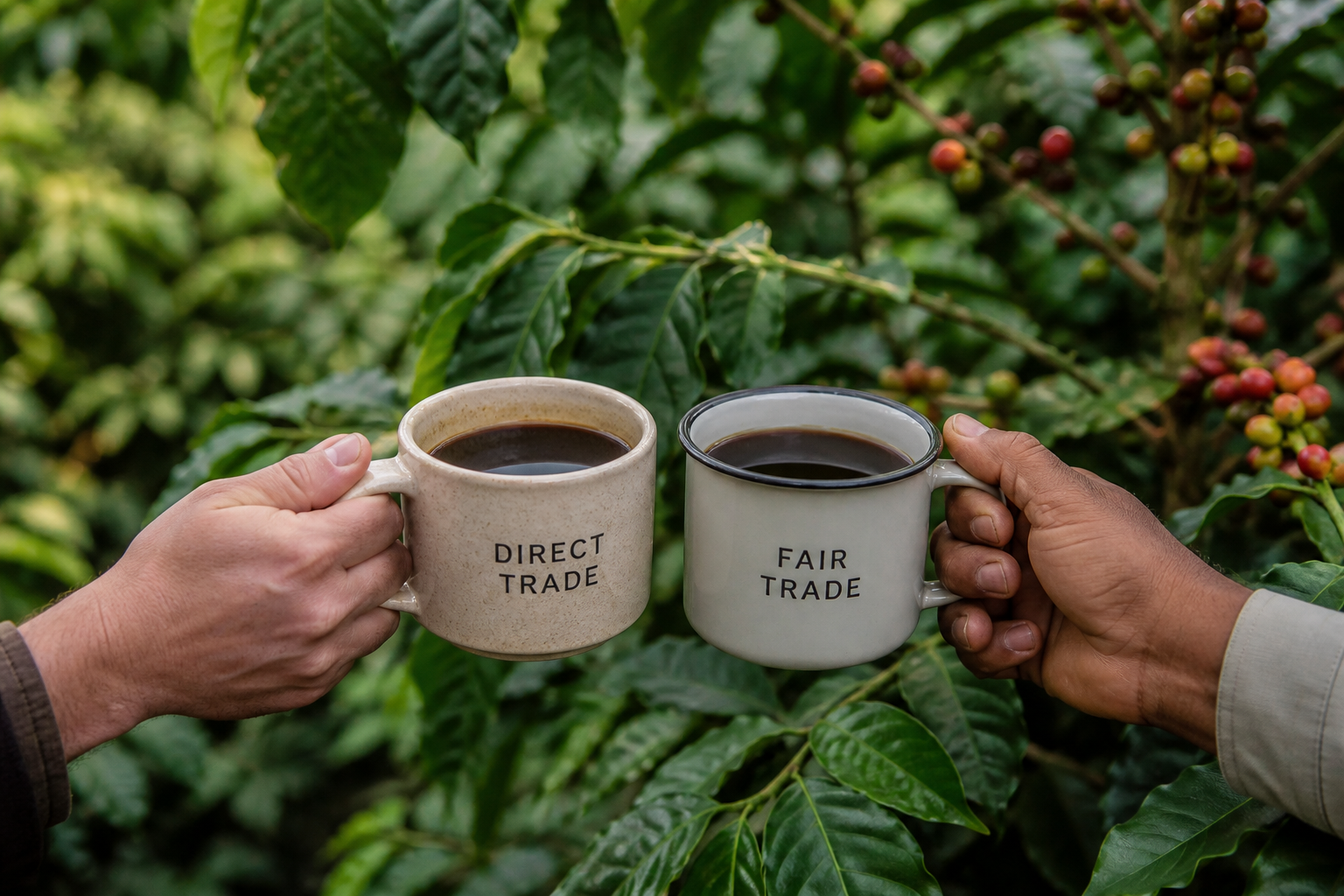
    Two hands each holding a plain mug of black coffee, one lettered DIRECT TRADE and the other FAIR TRADE, in front of a coffee shrub hung with ripening red and green cherries

    Two bags of coffee sit on a shelf. One says “Fair Trade Certified.” The other says “Direct Trade.” A shopper might assume these labels mean the same thing. Farmers got paid fairly, and someone checked. They don’t mean the same thing at all. One is a certification with a written standard, an independent auditor, and a published price floor. The other is a phrase a roaster can print on a bag with nobody checking a word of it. Knowing what each label leaves out matters more than most shoppers realize.

    What Fair Trade Certification Guarantees

    “Fair trade” isn’t one thing. It’s two separate certification systems, run by two different organizations, with two different price floors. Most bags don’t say which one applies. Fairtrade International, the Bonn-based group behind the original label, sets a minimum price. Farmer cooperatives must be paid that floor no matter how low the commodity market falls. For contracts signed on or after Dec. 1, 2026, that floor rises to $2.00 per pound for washed arabica, up from $1.80. A fixed $0.20-per-pound premium and a $0.40 organic differential come on top, according to the trade publication Daily Coffee News. Fair Trade USA is a separate organization. Its own history page dates the split from the international system to 2011, and, according to the certifier’s own coffee page, it runs its own standard: a guaranteed minimum of $1.40 per pound for washed arabica, plus a $0.20 social premium. Two certifiers, two different numbers, the same words on the bag.

    Advertisement

    Both systems require more than a price. Certification standards prohibit forced and child labor. They also require farmer organizations to meet business-capacity rules before they’re approved at all. But the premium doesn’t land directly in one farmer’s pocket. It’s paid to the cooperative instead, which votes on how to spend it – a warehouse, a cupping lab, a school, a loan fund. Advocates see that as the point: cooperatives make their own spending decisions, not a roaster. It also means the extra $0.20 a consumer imagines reaching one farmer’s hand more often becomes shared infrastructure.

    Where Fair Trade Certification Falls Short

    The most cited critique isn’t corruption. It’s a supply-and-demand mismatch. Fair trade coffee is a small share of the global specialty market. Cooperatives often grow more certified coffee than buyers want at the fair trade price. Research summarized in the Stanford Social Innovation Review, a Stanford-published magazine, found this creates a perverse incentive. Cooperatives route their lower-grade lots into the fair-trade channel, where the floor price applies regardless of cup quality. They sell their best beans on the open market instead, for more money. The certification doesn’t reliably signal quality in the cup. Whether it raises farmer income overall is a separate, genuinely contested question among agricultural economists – not a settled one.

    Direct Trade Coffee Meaning — And What It Doesn’t Guarantee

    “Direct trade” emerged in the 2000s as specialty roasters’ answer to fair trade’s limits. The idea: buy straight from a farm or mill, skip the middlemen, pay for cup quality instead of a commodity floor. Here’s the catch. Direct trade coffee has no legal definition. There’s no certifying body, no published standard, no third-party audit. The trade publication Perfect Daily Grind reported that the phrase “has no formal definition or certification.” Traders and roasters, it found, don’t necessarily have to substantiate that they bought coffee directly from farmers.

    That doesn’t make direct trade meaningless. Some roasters maintain real, multi-year relationships with individual farms. They pay well above any certification floor and publish the prices to prove it. But nothing stops a roaster from printing “Direct Trade” on a bag sourced through a conventional exporter, with no farm relationship at all. That’s exactly why trade press treats the phrase as marketing language first, a sourcing model second. It only earns the second label when a roaster backs it with an actual price and an actual name at origin.

    Direct Trade vs. Fair Trade Coffee: A Side-by-Side Comparison

    A short comparison, stripped of marketing copy:

    Written standard: Fairtrade International and Fair Trade USA both publish detailed rules. Direct trade has none.

    Third-party audit: Both fair trade certifiers use independent auditors. Direct trade relies on the roaster’s word.

    Minimum price: Fairtrade International guarantees $2.00/lb for washed arabica, for contracts signed on or after Dec. 1, 2026. Fair Trade USA guarantees $1.40/lb. Direct trade has no floor at all – it can pay more, or less, than either.

    Cup quality: Neither fair trade system grades for quality. Direct trade often correlates with higher quality, since roasters hand-pick lots. Correlation isn’t a guarantee, though.

    Where the money goes: Fair trade premiums go to the cooperative, which decides collectively. Direct trade payments usually go straight to the farm or mill owner. That can mean more money for that individual grower – or less for workers who aren’t owners.

    Advertisement — advertiser disclosure

    What This Means for the Cup You’re Buying

    Neither label is a shortcut to an ethical purchase. Neither is a scam, either. Fair trade certification buys a verified price floor and real labor protections. The cost: a system that doesn’t guarantee quality, and doesn’t always turn into higher farmer income once cooperative overhead is counted. Direct trade buys the possibility of a genuine relationship and real transparency. That only holds when the roaster actually practices what the word implies, and discloses what it paid. The only way to know which you’re getting is to ask a plain question: what price did the roaster pay, and can they show it? A bag that answers that honestly, certified or not, does more than any label on its own.