In this piece
A grinder’s uniformity is a measured width. It is how tightly the ground mass gathers around one particle size, and how much of it scatters into dust below that size and fragments above it. Particle size then sets how fast water empties each grain. In an extraction model of a brew that ends within minutes, the smallest grains come out close to spent while the largest are still giving up their centres.
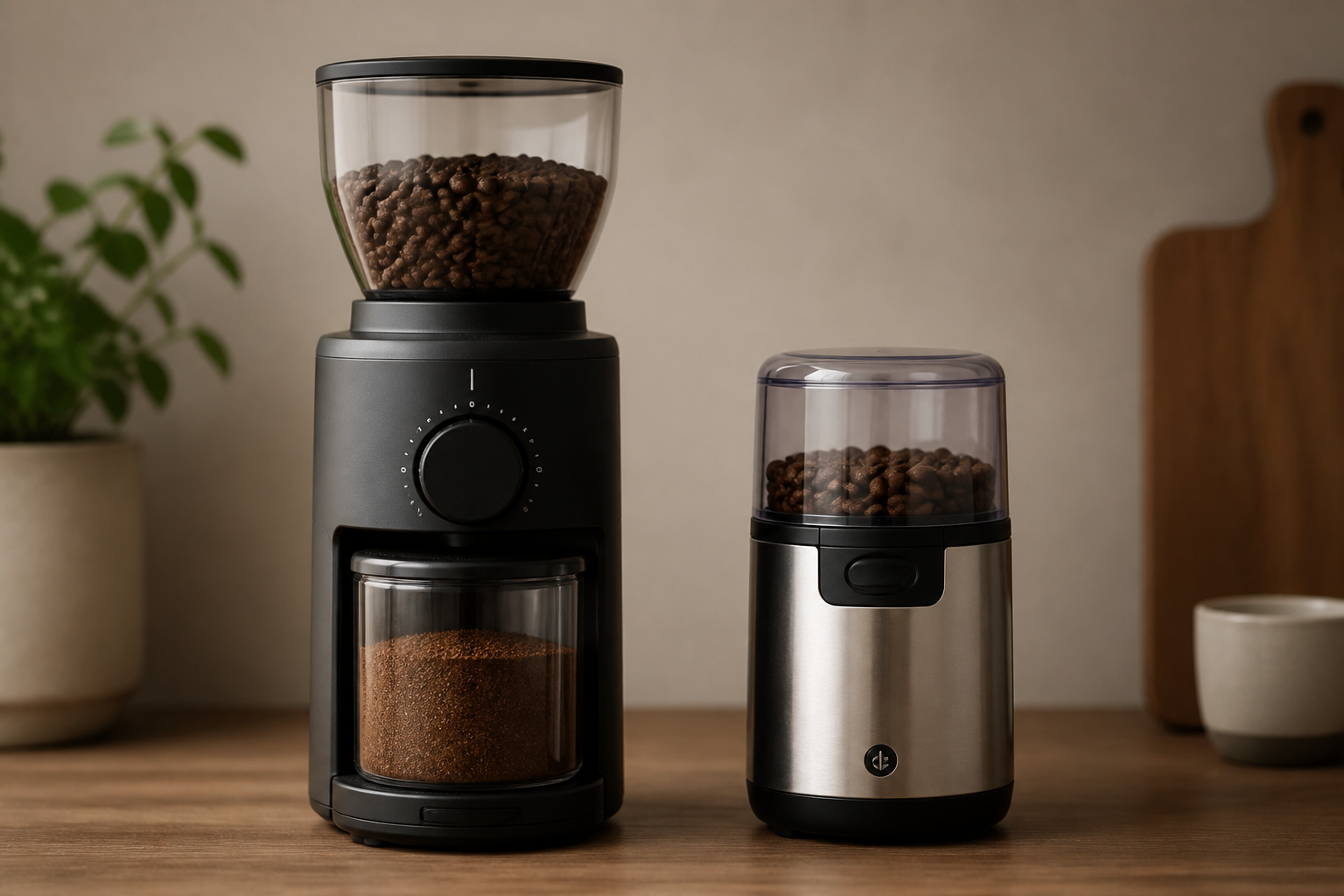
Particle sizes are set by an aperture in one grinder and by the clock in the other
The burr grinder in a 2016 Scientific Reports study by Uman and colleagues fractures beans between two burrs, one stationary and one mobile. The team held the aperture between them constant for every coffee they measured, while bean origin and bean temperature varied. A blade grinder has one size control. It is the length of time the machine runs. Murray and Laredo, writing in the Journal of Food Research in 2015, describe beans cut “by means of a high speed turning blade”. That gives a distribution “usually broad and subject to variability based on somewhat arbitrary grinding time.”
Murray and Laredo then measured that spread in a household blade grinder. They ground 37-gram samples of whole beans for between 1.5 and 84 seconds. Each sample went through a stack of eight sieves, with openings from 9.5 millimetres down to 75 microns. Every fraction was then weighed. As grinding time grew, the distribution became “more narrow and asymmetric”. After 84 seconds most of the weighed sample sat between 75 and 300 microns, with 4% below 75 microns. That sieve record puts measured sizes on the chunks-and-dust picture of a blade grind. The spread was widest at the shortest grinding times, which leave the coarsest grinds, and narrowed as grinding drove the whole dose toward fine sizes.
Uman’s group measured the burr side by laser diffraction. They ground coffees from four origins on a set of Turkish burrs, and found the surface-area profile “distinctly bimodal.” Two modes sit in that profile. They are near 27 microns for the fines, and near 257 to 282 microns for particles roughly ten times wider. By particle number, a tally the numerous fines dominate, 99% of that burr grind measured 70 microns across or less, and the fines carried “the majority of the accessible surface area.” Grinding the beans colder gave a narrower distribution and a smaller mean size. The two records come from different laboratories. They used different beans, and they tally particles differently: the laser profiles by number or by surface area, the sieves by weighed mass.
A grain’s surface is emptied in seconds and a coarse grain’s core over minutes
Water reaches the solubles in a coffee grain by two routes. A 2016 extraction model by Moroney and colleagues in the Journal of Mathematics in Industry names both. Extraction from a single grain, in their words, is controlled by two processes, “a rapid dissolution of coffee from the grain surfaces in conjunction with a much slower diffusion of coffee through the tortuous intragranular pore network to the grain surfaces.” The grains are treated as a dilute, well-mixed suspension, with parameters from the group’s experimentally validated 2015 paper. The model then gives each route a timescale.
For a fine drip-filter grind the surface timescale is about 1.2 seconds and the diffusion timescale about 42 seconds. For a relatively coarse grind they are about 19 and 270 seconds. The coarse grind’s diffusion clock therefore runs about 6.4 times as long, and its surface clock about 16 times as long. In the model’s definitions each timescale grows with a Sauter mean diameter, the size of a sphere sharing the grains’ ratio of volume to surface, so a larger grain runs slower on both routes.
In a wide distribution those clocks run side by side within a single brew. Uman’s group states the consequence plainly: “variable accessible surface area causes the small particles to extract more rapidly relative to larger ones.” Given long enough, the slow clock finishes too. Liang, Chan and Ristenpart, writing in Scientific Reports in 2021, ground coffee across a more than twofold range of median particle size, measured by laser diffraction. Each full-immersion brew stood until its dissolved solids held steady. That took 20 minutes at 99°C and 60 minutes at 80°C.
At that equilibrium the extraction yield averaged 20.70 ± 1.08% at brew ratios of 3 and above, and “variation in brew temperature or grind sizes did not considerably alter” it. The same paper describes flow brewing as the case where “the flow rate, brew ratio, and total brew time can be varied.” Taking the well-mixed model’s clock as a guide to a percolation bed, a brew that drains in four and a half minutes has run for about one diffusion timescale of the coarser grind. Its coarse grains are then still giving up solubles from their cores when the water leaves.
Flavour has been measured on brewed coffee, both as whole-cup averages and as time-sliced fractions. At the UC Davis Coffee Center, 12 panelists scored drip brews of one washed coffee from Honduras. Sourness rose with total dissolved solids, a measure of strength. It fell as percent extraction rose. Bitterness, charted for a medium roast, rose with both. Those findings come from the researchers’ own summary of their 2020 Journal of Food Science paper, published by the Specialty Coffee Association, an industry association. A trained panel from the same group also tasted drip brews collected in 30-second fractions. The earlier fractions, which carry more dissolved solids, were “systematically more bitter and more sour” than the later ones.
A broad distribution is brewed as several extractions at once
In a brew stopped short of equilibrium, the extraction kinetics put a broad grind’s fines further along than its largest fragments, inside one cup. A matched-yield tasting of a blade grind against a burr grind is the experiment that would score what that split does to flavour. The UC Davis whole-cup results for that one coffee had sourness falling as extraction rose. In a medium roast, bitterness rose as extraction rose. Mapped onto those results, the split points to bitterness from the fines and sourness from the largest fragments, at an average yield between them.
Article sources
- Uman et al., ‘The effect of bean origin and temperature on grinding roasted coffee’, Scientific Reports (2016), peer-reviewed, open access
- Murray & Laredo, ‘Effect of Home Grinding on Properties of Brewed Coffee’, Journal of Food Research 4(1) (2015), journal article page, open access
- Moroney et al., ‘Coffee extraction kinetics in a well mixed system’, Journal of Mathematics in Industry (2016), peer-reviewed, open access
- Frost, Batali, Guinard & Ristenpart, ‘Towards a New Brewing Chart’, SCA News (Specialty Coffee Association, an industry association) — the authors’ summary of their 2020 Journal of Food Science paper