Bills & Beans

Straight Talk on Coffee, Money, and Liberty

Tag: How It Works

Mechanism and terminology: what a thing is, and how it works.

  • Why Your Coffee Tastes Different at Home Than at the Café

    Why Your Coffee Tastes Different at Home Than at the Café

    Water is about 98% of a cup of coffee and the solvent doing the extraction — its mineral content decides how much flavour comes out of the grounds, and which flavours those are.

    Key takeaways

    • Water is roughly 98% of the cup. It is the solvent, not the background.
    • Too hard, and extraction saturates early: the cup lands flat and often bitter.
    • Too soft, and there is nothing for flavour compounds to bond with: the cup lands thin however long you brew.
    • Calcium binds the heavier notes — chocolate, caramel. Magnesium binds the bright ones — florals, citrus. A good cup needs both.
    • The SCA targets: TDS around 150 mg/L, hardness roughly 51–68 mg/L, alkalinity around 40 mg/L, pH 6.5–7.5.
    • A $15 TDS meter tells you which direction to fix before you spend anything on gear.
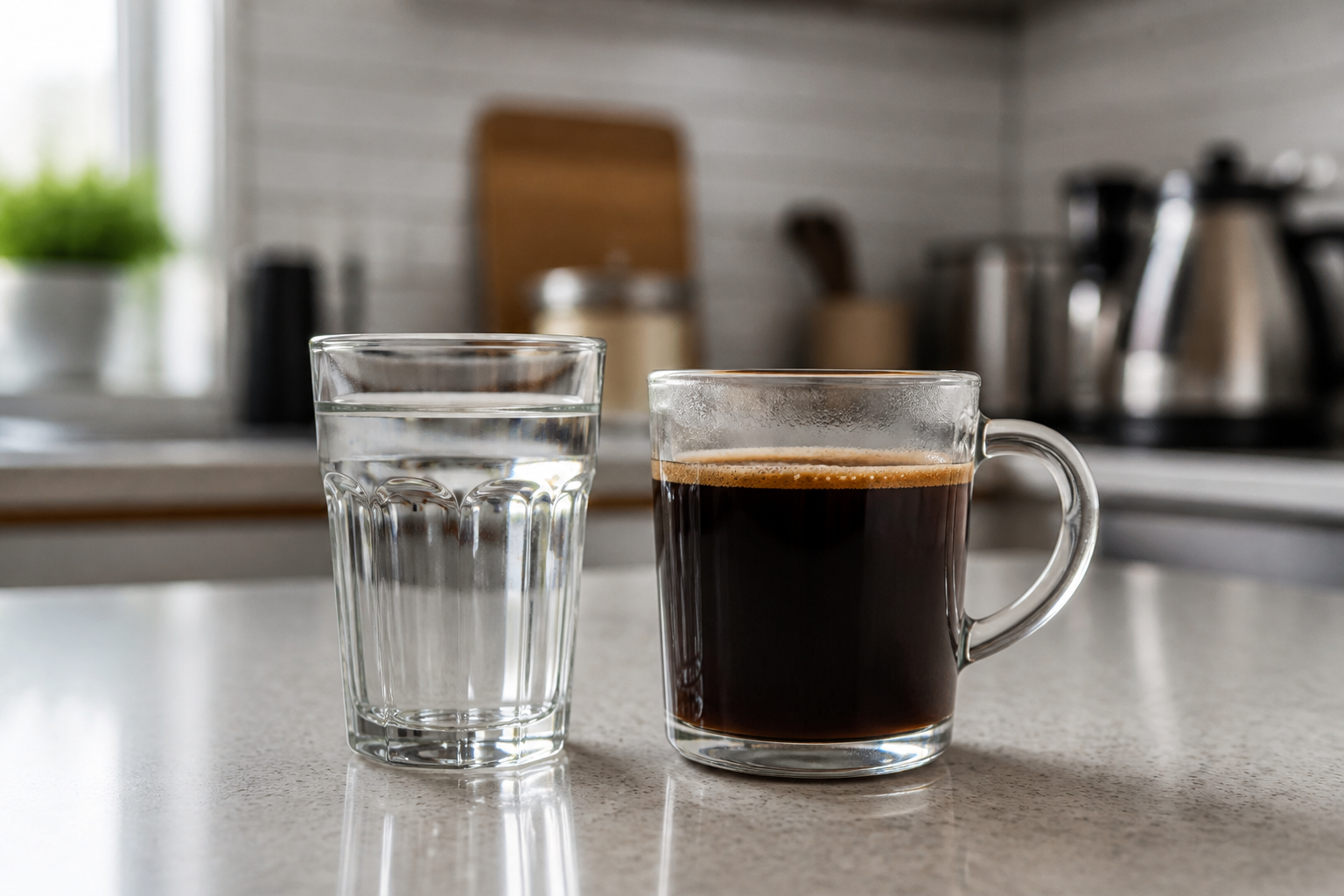
    A tall glass of clear water standing beside a glass mug of black coffee on a pale speckled kitchen counter, with a kettle, storage canisters and a potted plant out of focus behind them

    Same beans. Same grind size. Same brewer, even, if you bought the exact model your favorite café uses. And the coffee still tastes flatter, or thinner, or just off. Before you blame your technique, check something most people never think about: your water.

    Water makes up about 98% of a cup of coffee. It isn’t a neutral background ingredient. It’s the actual solvent doing the extraction. Its mineral content changes what comes out of the grounds, and how the result tastes.

    Hard water and soft water pull different things out of the same beans

    “Hard” water carries more dissolved calcium and magnesium. “Soft” water carries less. Both extremes cause real problems, just in opposite directions.

    Water that’s too hard extracts fast and stops early. It’s already carrying so many minerals that it saturates quickly. It grabs flavor compounds early, then quits. The result is a flat, often bitter cup that undersells the beans. This shows up a lot in places with naturally mineral-heavy tap water. Parts of the Midwest and Texas are common examples.

    Water that’s too soft has the opposite problem. Distilled water, or water run through an aggressive home softener, has almost nothing in it to bond with flavor compounds. Extraction stays weak no matter how long you brew. You end up with something thin and watery, even from great beans and a careful brew.

    Advertisement

    The two minerals doing the real work

    Calcium and magnesium aren’t interchangeable. They tend to grab different things.

    Calcium binds more with heavier, rounder flavor compounds — think chocolate, caramel, brown sugar. Magnesium binds more with brighter aromatics — florals, citrus, berry notes. A healthy mix of both tends to produce a cup with real depth and real brightness. Lean too hard on one mineral, and you lose the other side of that balance.

    The four numbers that matter

    The Specialty Coffee Association publishes a water quality standard for brewing, built around a handful of measurable targets:

    • Total dissolved solids (TDS): target around 150 mg/L, acceptable range roughly 75–250 mg/L.
    • Calcium/magnesium hardness: ideal range roughly 51–68 mg/L (about 3–4 grains per gallon).
    • Total alkalinity: around 40 mg/L.
    • pH: between 6.5 and 7.5, with 7.0 as the target.

    Sodium and chlorine matter too, mostly by their absence. Chlorine especially should be filtered out entirely — it shows up directly as an off-flavor, no mineral balance can fix.

    You don’t need to hit these numbers exactly. Cafés chasing competition-level consistency care about precision. A home brewer mostly just needs to land in the right neighborhood.

    Advertisement — advertiser disclosure

    You don’t need a lab to check water quality

    Two practical options cover almost everyone.

    A cheap TDS meter, around $15, tells you roughly where your tap water sits. That’s often enough to diagnose “too hard” versus “too soft,” without much further guesswork.

    Pre-mixed brewing water, sold specifically to hit the SCA targets, is the simplest fix for a known problem — hard well water, an aggressive softener, or a chlorine-heavy municipal supply. It costs more than tap water. It costs far less than another bag of good beans brewed badly, over and over, without knowing why.

    If you’re on a municipal supply and don’t know your water’s mineral content, check first. Most utilities publish an annual water quality report online. It’s worth five minutes, before you spend real money chasing a “better” grinder that was never the actual problem.

    A quick gut-check before you buy anything

    Notice where the coffee tastes off. Flat and a little bitter, even with a fresh light roast, points toward water that’s too hard. Thin and watery, even with a slow, careful pour, points toward water that’s too soft. That alone is often enough to know which direction to fix, before a single test strip.

    The short version

    Rule out the water before you re-dial anything

    Grind size and brew ratio get most of the attention, and they matter. But both are working through your water, not around it. If a dialed-in recipe still tastes wrong, or the same beans taste better somewhere else, rule out the water first. It’s usually the faster fix, and often the real answer.

    Article sources

    1. Pulled Journal — Coffee Brewing Water: TDS, Hardness, and the Cheap Fixes That Work (SCA target/range figures, calcium vs. magnesium flavor-binding explanation, hard/soft water extraction effects)
    2. 43 Factory Coffee — Dissecting SCAA’s Water Quality Standard (cross-check on SCA TDS, hardness, alkalinity, pH, and sodium figures)
    3. Third Wave Water — What Is SCA Water Standard? (cross-check on the same standard, chlorine/clarity requirements)
  • Grind Size Isn’t a Setting. It’s the First Thing to Check.

    Grind Size Isn’t a Setting. It’s the First Thing to Check.

    Grind size is not a dial setting. It is how long your brew method leaves water in contact with the grounds — and matching those two is what decides whether the cup tastes right.

    Key takeaways

    • Of the four things that shape a cup — bean, roast, water, grind — grind size does the most damage when it is off, and it is the one people check last.
    • Longer contact time wants a coarser grind: cold brew steeps 8 to 24 hours and takes the coarsest; espresso runs in under 30 seconds and takes the finest.
    • Sour, thin or weak means under-extracted. The fix is a finer grind, not more coffee.
    • Bitter, harsh or dry on the finish means over-extracted. The fix is a coarser grind.
    • A blade grinder makes dust and chunks in the same batch, so half the cup over-extracts while the other half under-extracts. No setting fixes a spread.
    • When you are not sure which way to move, start coarse. Walking a grind finer is easier than rescuing a bitter cup.
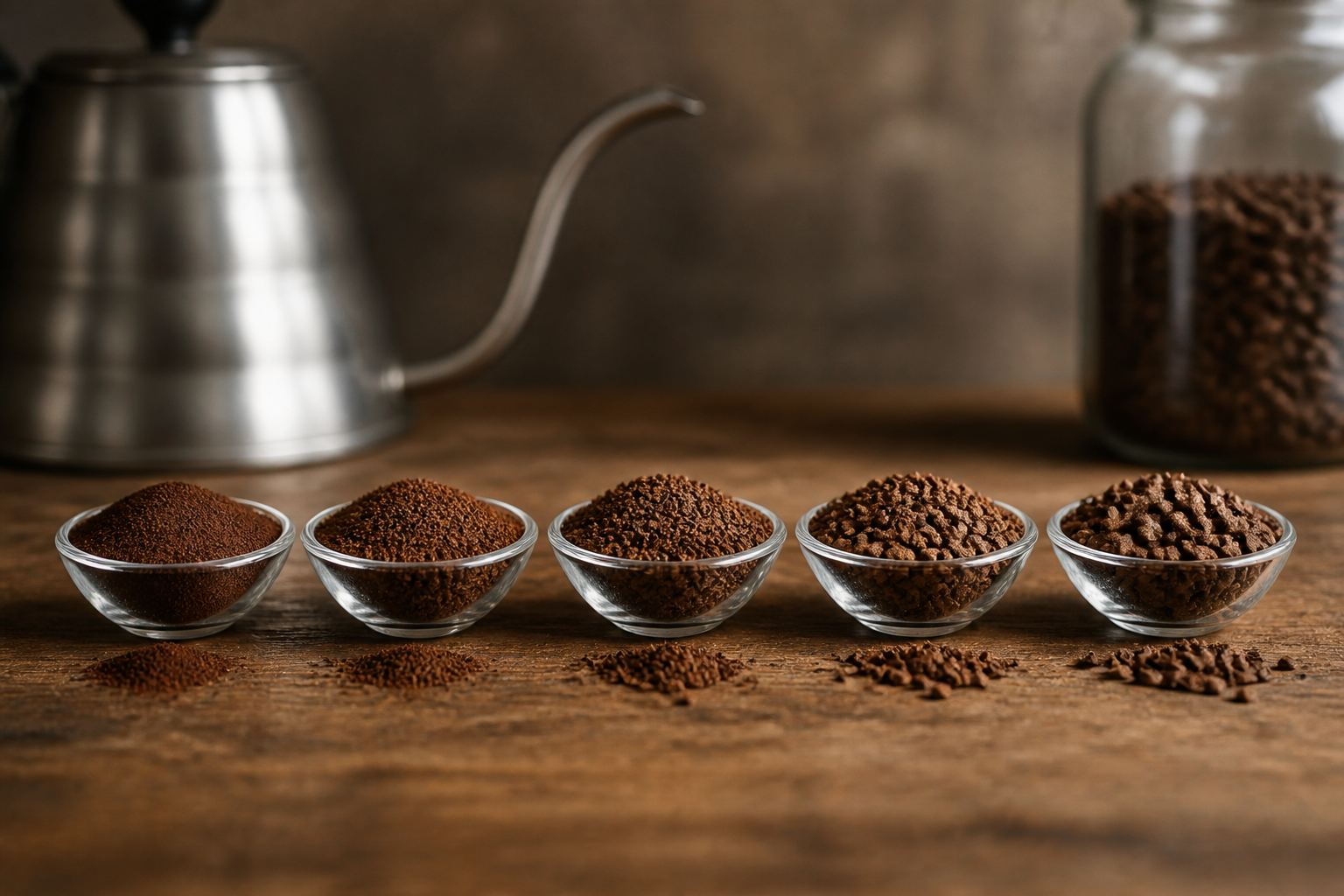
    Five small glass bowls in a row on a wooden counter, each holding coffee ground to a different size, from fine powder at the left to coarse chunks at the right, with a little of each spilled on the wood in front of it and a gooseneck kettle and a jar of beans out of focus behind

    Most people troubleshoot bad coffee backwards: better beans, then a better machine, then eventually a better grinder. Wrong order. Of the four things that actually shape your cup — bean, roast, water, grind — grind size does the most damage when it’s off, and it’s the one nobody checks first.

    Grind size isn’t really “fine” or “coarse” as abstract dial settings. It’s about how long your brew method leaves water in contact with the grounds. Longer contact time needs a coarser grind; shorter contact time needs a finer one. A French press holds water for several minutes. Espresso is done in under 30 seconds. Same beans, wildly different grinds.

    Two ways it goes wrong

    Too fine for the method, and you’re over-extracting. The water pulls out more than it should, and you get a harsh, bitter, ashtray note. Too coarse, and you’re under-extracting. Not enough gets pulled out, and you get a thin, weak, sour cup — no matter how much coffee you used. That second one trips people up constantly. “Weak” doesn’t mean “not enough coffee.” It means under-extraction, and the fix is a finer grind, not more grounds.

    Advertisement

    Why a blade grinder sabotages you even at the “right” setting

    This is the real case for a burr grinder over a blade grinder, and it’s mechanical, not snobbery. A blade grinder chops beans into a random spread of particle sizes — chunks and dust in the same batch. A burr grinder crushes beans between a fixed gap, producing one uniform size. Burr grinders come in two basic types, flat and conical. The type matters far less than the fact that it’s a burr at all.

    That uniformity is what lets water extract evenly. A blade grinder’s mixed particles don’t extract evenly: the dust over-extracts and turns bitter, while the chunks in the same cup are still under-extracted and sour. Both at once, in the same brew. Pulsing the blade grinder in short bursts knocks down the biggest chunks, but it doesn’t fix the real problem. You still get a wide spread of sizes, just a slightly narrower one. No single setting fixes that, because there isn’t one setting — there’s a spread.

    Grind size by method, at a glance

    The contact-time principle above turns into real settings once you match it to what’s actually brewing. Cold brew steeps for 8 to 24 hours, the longest contact time of any common method, so it wants the coarsest grind of the bunch. French press holds grounds for several minutes, typically 4 to 7 — still coarse, but less extreme. Drip machines and pour-over cones move water through faster than either immersion method, which calls for a medium grind. Espresso pushes water through in under 30 seconds. That’s the shortest contact time by far, and it needs the finest grind of any of them.

    These are starting points, not fixed settings. Your specific grinder, beans, and water still decide the exact dial.

    Advertisement — advertiser disclosure

    Dialing it in without a lab

    Taste the cup and let it tell you which way to move. Sour, thin, or weak → grind finer. Bitter, harsh, or dry on the finish → grind coarser. Adjust one step, brew again, taste again. If you’re not sure which way to start, err coarse. It’s easier to walk a grind finer over a few brews than to rescue an over-extracted, bitter cup. This is slower than following a settings chart, but it accounts for your actual water, beans, and grinder. Someone else’s number is only a starting point.

    The short version

    The grind comes first, and the grinder comes before that

    Grind size is the dial to adjust before you blame the beans, the water, or the machine. And if you’re still on a blade grinder, that upgrade moves the needle before any fancier gear does. Not because burr grinders are trendy — because inconsistent particle size makes even the “right” setting meaningless.

    Article sources

    1. Coffee preparation — Wikipedia (grind size/contact time relationship, over- and under-extraction definitions, uniformity, method-specific brew times)
    2. Barista Hustle — Coffee Extraction and How to Taste It (sour = under-extracted, bitter = over-extracted taste profiles)
  • Roth vs. Traditional IRA: The Break-Even Is a Tax Rate, Not an Age

    Roth vs. Traditional IRA: The Break-Even Is a Tax Rate, Not an Age

    A Roth IRA and a Traditional IRA hold the same investments for the same purpose. The only difference is whether you pay the tax now or in retirement.

    Key takeaways

    • The whole choice is one question: do you want the tax break now, or tax-free withdrawals later?
    • Traditional usually wins if you expect a lower bracket in retirement. Roth usually wins if you expect the same bracket or a higher one.
    • For 2026, direct Roth contributions close at $168,000 modified AGI filing single and $252,000 married filing jointly, with the phase-out starting at $153,000 and $242,000.
    • Traditional has no income cap on contributing, but if you are covered by a workplace plan the deduction phases out between $81,000 and $91,000 single, or $129,000 and $149,000 joint.
    • The 2026 IRA limit is $7,500 across both accounts combined, plus an $1,100 catch-up contribution at 50 or older.
    • If you cannot tell which bracket you will land in, default to Roth and revisit each year. The delay costs more than picking “wrong.”
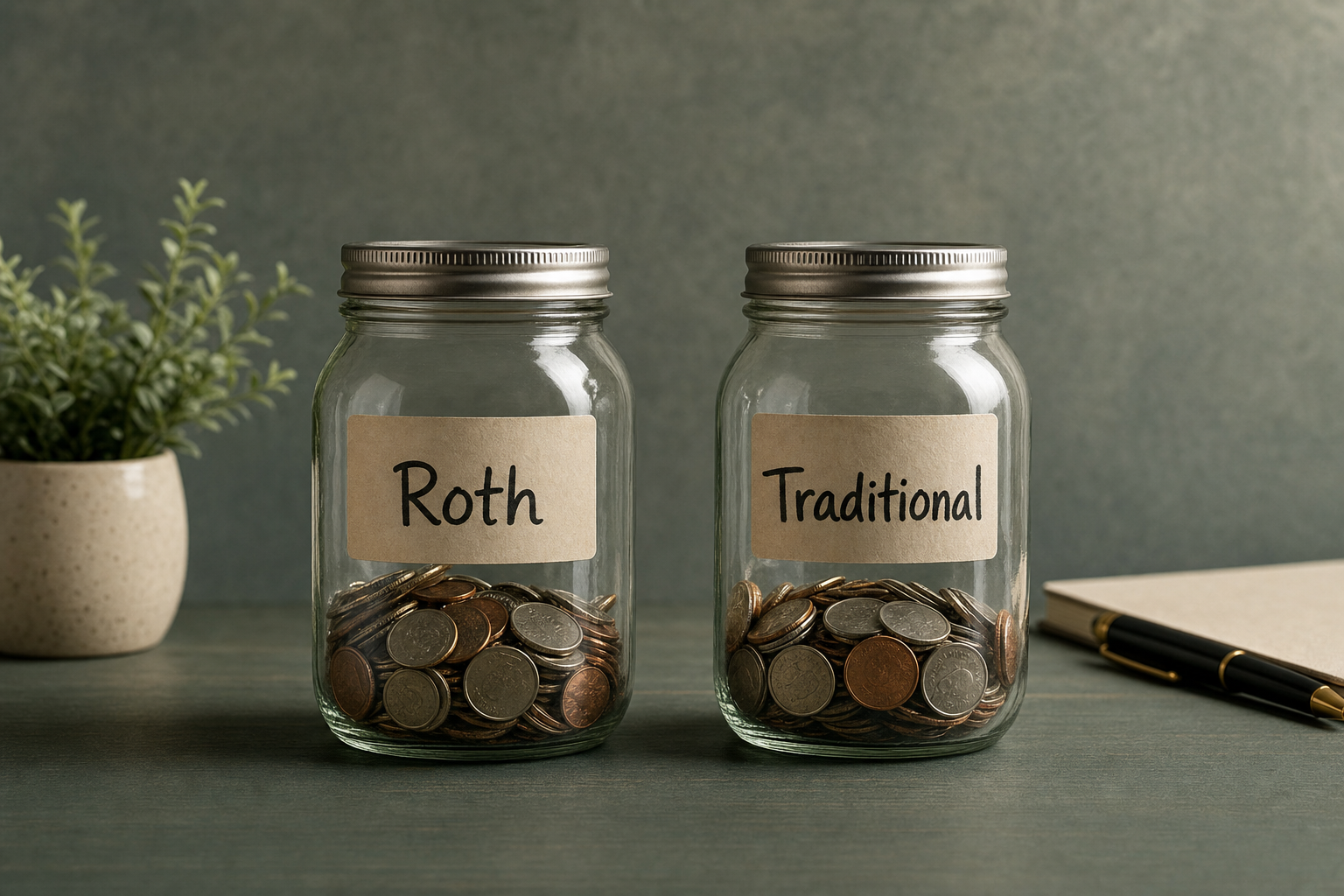
    Two identical glass jars of mixed coins side by side on a dark wooden surface, hand-lettered labels reading Roth and Traditional

    Most people freeze up on this decision. They read three articles, still don’t have an answer, and end up putting money in neither account for another year. That delay costs more than picking “wrong” ever would.

    Here’s the good news: the core decision is simpler than it looks. Almost everything else you’ve read about Roth versus Traditional comes down to one question.

    When do you want to pay the tax?

    A Traditional IRA gets you a tax break now. You contribute pre-tax dollars, the money grows tax-deferred, and you pay ordinary income tax when you withdraw it in retirement. A Roth IRA flips that. You contribute after-tax dollars today, but qualified withdrawals in retirement — including all that growth — come out completely tax-free.

    Same account type, same investment menu, same purpose. Opposite timing on the tax bill.

    The real question isn’t “which is better.” It’s “which tax rate is lower.”

    If you expect to be in a lower tax bracket in retirement than you are right now, Traditional usually wins. You take the deduction while your rate is high, and pay tax later while your rate is lower.

    If you expect to be in the same bracket or a higher one, Roth usually wins. That’s common for people early in their careers, or anyone who thinks tax rates in general are headed up. You lock in today’s rate instead of gambling on tomorrow’s.

    Nobody can predict their exact future bracket with certainty. That’s fine. You’re making a reasonable bet, not a permanent one.

    Advertisement

    The income limits that can decide it for you

    For 2026, the IRS caps who can contribute directly to a Roth IRA based on income. If your modified adjusted gross income falls above $168,000 filing single (or $252,000 married filing jointly), you can’t contribute to a Roth directly at all. The phase-out — where your allowed contribution shrinks — starts at $153,000 single and $242,000 joint.

    Traditional IRA contributions have no income cap. Anyone with earned income can contribute. But if you’re covered by a retirement plan at work, the tax deduction phases out between $81,000 and $91,000 single, or $129,000 and $149,000 joint, for 2026.

    If you’re a high earner locked out of a direct Roth contribution, a “backdoor Roth” — contributing to a Traditional IRA, then converting it — is the standard workaround. It has its own rules and tax wrinkles worth a dedicated look, so treat that as a separate decision once you know you need it.

    A decision rule that works for beginners

    If you genuinely don’t know which bracket you’ll land in, split the difference: contribute to both, or default to Roth. Here’s why: you already know today’s rate. You’re paying it either way — through lower take-home pay with Traditional, or after-tax dollars into Roth. Locking in a known rate beats betting on an unknown future one.

    There’s a second reason younger savers lean Roth. Your income, and likely your tax rate, tend to be lowest early in your career. Decades of tax-free growth starting from that low-rate point is hard to beat. That advantage shrinks the closer you get to retirement.

    Advertisement — advertiser disclosure

    A quick example

    Say you’re 30, in the 22% federal bracket, and you contribute the full $7,500 for 2026.

    Put it in a Traditional IRA, and you shave roughly $1,650 off this year’s tax bill — 22% of $7,500. That money grows tax-deferred, but every dollar you withdraw in retirement, contributions and growth alike, gets taxed as ordinary income at whatever rate applies then.

    Put it in a Roth IRA instead, and there’s no deduction this year. You pay that $1,650 now, same as if you’d never contributed. But decades of growth on that $7,500 come out completely tax-free later.

    The whole bet comes down to one comparison: your 22% now versus your real tax rate in retirement. Lower later, and Traditional wins by roughly the gap. Same or higher later, and Roth wins outright — you locked in 22% instead of whatever your retirement-year rate turns out to be.

    Contribution limits for 2026

    The IRA contribution limit is $7,500 for 2026, up from $7,000 in 2025. That cap applies across Traditional and Roth combined — you can split it between both, but the total still can’t exceed $7,500. If you’re 50 or older, you get an extra $1,100 catch-up contribution, bringing your total to $8,600.

    The short version

    The account you use beats the one you optimize

    Don’t let the tax-bracket guessing game keep you on the sidelines. If you’re not sure, contribute to a Roth, contribute something, and revisit the split every year as your income changes. The account you actually use beats the theoretically optimal one you never open.

    The decision rule here compares one federal rate today against one guessed rate in retirement; filing status, state tax, workplace-plan coverage and a household’s other retirement income all move that comparison, and the contribution and income limits quoted are the ones set for tax year 2026.

    Article sources

    1. IRS — 401(k) limit increases to $24,500 for 2026, IRA limit increases to $7,500 (2026 IRA contribution limit, catch-up limit, Roth IRA income phase-out ranges)
    2. IRS — IRA Deduction Limits (Traditional IRA deductibility phase-out ranges for savers covered by a workplace plan)
    3. Fidelity — Backdoor Roth IRA: Is it right for you? (backdoor Roth mechanics for high earners phased out of direct contributions)