Bills & Beans

Straight Talk on Coffee, Money, and Liberty

Author: Catherine Bellamy

  • Reading a Coffee Bag Label: Which Lines Federal Law Requires, and Which Ones the Roaster Chose

    Reading a Coffee Bag Label: Which Lines Federal Law Requires, and Which Ones the Roaster Chose

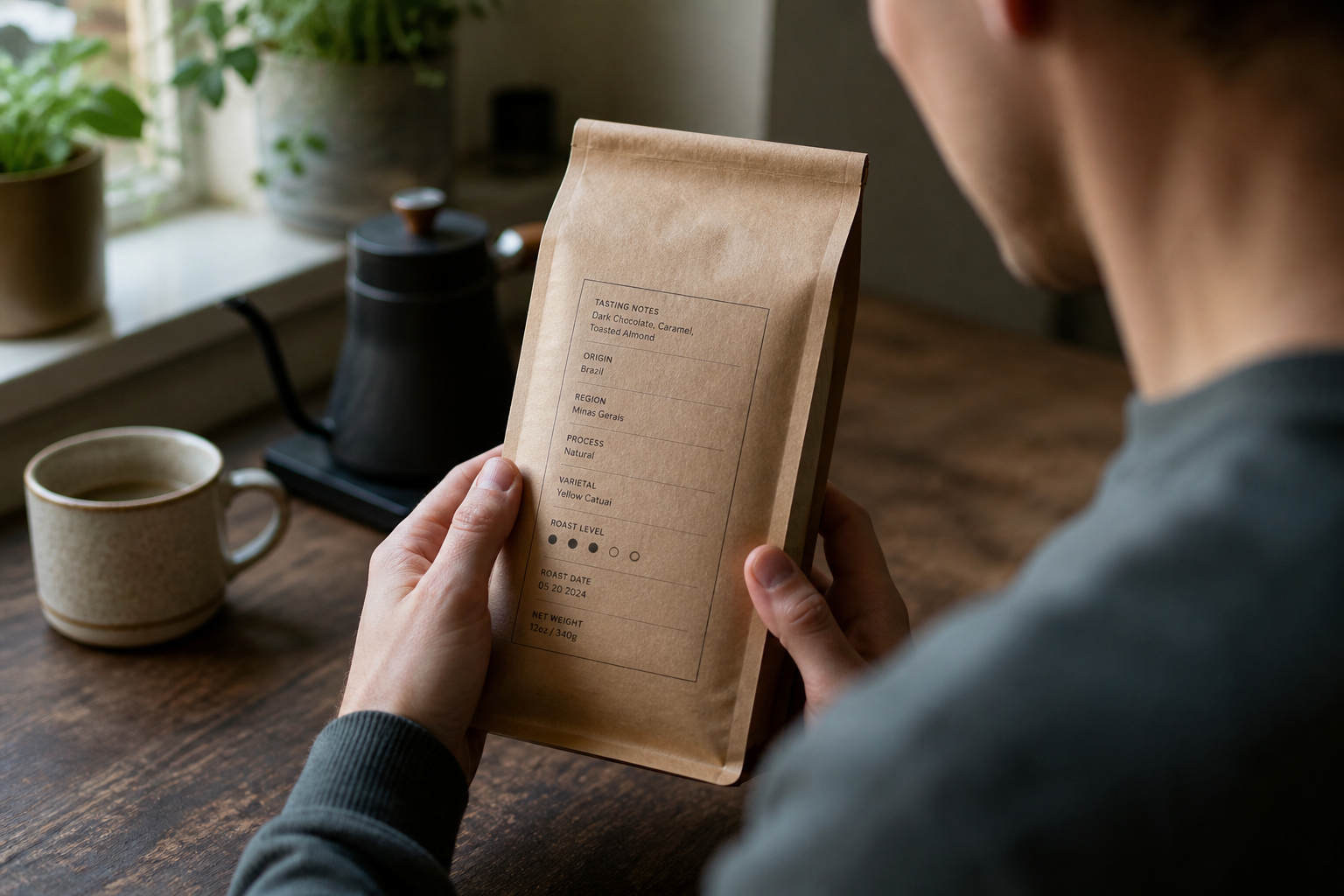
    Seen over a person's shoulder, two hands holding an unbranded kraft coffee bag open to its information panel, which lists tasting notes, origin, region, process, varietal, a roast-level scale, roast date and net weight, with a mug and a gooseneck kettle out of focus behind

    Every line on a bag of coffee is either required by federal law or chosen by the roaster. On a plain bag three are required – what it is, how much is in the bag, and who is answerable for it. Country of origin looks like a fourth and, on coffee roasted in America, usually is not.

    “Net wt. 12 oz,” and the two lines that keep it company

    A retail bag of plain roasted coffee carries three mandatory declarations, and two of them are about the package rather than the coffee. The net quantity of contents goes on the principal display panel, inside the bottom 30 percent of it. The name and place of business of the manufacturer, packer or distributor is required too, down to the ZIP code. If the firm named did not roast the coffee, 21 CFR 101.5(c) requires the name to be qualified. The qualifier must express the facts – “Distributed by”, or similar wording. Add a second ingredient – a flavouring, chicory – and 21 U.S.C. 343(i)(2) and 21 CFR 101.4(a)(1) add a fourth line, an ingredient statement.

    Advertisement

    The third is the statement of identity, the only required line that touches what is inside. Where a food is sold in optional forms, 21 CFR 101.3(c) makes the form part of that statement. The exception is a form visible through the container, or shown in a vignette. That is why an opaque bag says whole bean or ground. It is also where the requirement stops: how coarse is a question the label never answers.

    One absence is deliberate. Coffee beans, whole or ground, are exempt from nutrition labelling under 21 CFR 101.9(j)(4), which names them outright. The exemption holds only while the food bears no nutrition claim and no other nutrition information – on the label, in labelling or in advertising. Make one anywhere and the panel comes back.

    “Product of Colombia,” a mark that attaches at the border, not on the shelf

    Country of origin marking is a customs duty, not a food-labelling one. Except as the statute itself provides otherwise, 19 U.S.C. 1304(a) requires every article of foreign origin to be marked with the English name of its country of origin. The marking has to indicate that origin to an ultimate purchaser in the United States. The question is who that purchaser is. A U.S. firm that converts the import into an article of different name, character or use becomes the ultimate purchaser under 19 CFR 134.35(a). The article is then excepted from marking.

    Customs and Border Protection has held for more than 30 years that roasting green coffee produces an article of different name, character and use. That position rests on rulings from 1983 and 1984 which found roasting sufficient to change coffee’s character and use. Its 2017 final determination, HQ H291135 at 82 FR 55387, was issued for government procurement rather than marking. So the country name on an American-roasted bag is usually the roaster’s line.

    “Roasted on,” a date line no federal rule asks for

    This is the most useful line on the bag and the least governed. The FDA is flat about it: “Except for infant formula, manufacturers are not required by Federal law or regulation to place quality-based date labels on packaged food”. No roast date, no best-by, no sell-by. The agency supports “Best if Used By” as an industry standard phrase, and supporting is not requiring.

    “USDA Organic,” the optional line that brings a rulebook with it

    Organic is where the argument turns. Nothing requires a roaster to say a word about organic production. Say it, and 7 CFR 205.300(a) applies. The term may only be used on products produced and handled under that part. The thresholds run by weight, excluding water and salt. “Organic” takes at least 95 percent organic ingredients, “made with organic” at least 70, and “100 percent organic” means exactly what it says. Certification under 7 CFR 205.100(a) is mandatory, and the label must name the certifying agent. An operation with $5,000 or less in annual gross organic sales is exempt from certification. 7 CFR 205.310(a) then bars it from the USDA seal.

    Every other seal on the bag works differently. A certifier’s mark is defined by the private organisation that wrote the standard behind it, and what those standards buy is a separate argument this site makes elsewhere.

    “Single origin, washed, Gesha, high grown,” four claims no federal rule defines

    These are the lines people buy on, and no federal rule defines any of them. That is a negative, so here is what was checked. FDA’s standards of identity sit in 21 CFR parts 130 through 169, and none of them is coffee. Part 102, the common-or-usual-name part for foods with no standard, runs to eighteen sections and none is coffee either. A full-text search of the Code of Federal Regulations returns no definition of “single origin”, “specialty coffee”, “Gesha” or “high grown”. What does apply is 21 U.S.C. 343(a)(1), which deems a food misbranded if its labelling is false or misleading in any particular. No definition is not the same as no law. It means there is no yardstick.

    The line as it appears on a bagWho defines itThe defining text, rule number or standard
    “Coffee — whole bean” or “ground”federal rule21 CFR 101.3(a) and (c); the form is part of the statement of identity, except where it is visible through the container or shown in a vignette
    “Net wt. 12 oz”federal rule21 CFR 101.7(a), on the principal display panel
    “Distributed by [firm], city, State, ZIP”federal rule21 CFR 101.5(a), (c) and (d)
    “Product of Guatemala” on coffee imported already roastedfederal rule19 U.S.C. 1304(a); 19 CFR 134.11; 19 CFR 134.1(d)(3), which makes the retail buyer the ultimate purchaser of an article sold at retail in its imported form
    “USDA Organic” or “Organic”federal rule7 CFR 205.300(a), 205.301(b), 205.303(b)(2); certification under 205.100(a)
    No Nutrition Facts panelfederal rule21 CFR 101.9(j)(4); the exemption lapses if the food bears a nutrition claim on the label, in labelling or in advertising
    Any other certifier’s sealcertifier standardthat private organisation’s own published standard
    “Roasted on” or “Best if Used By”nobodyFDA: not required by Federal law or regulation, except for infant formula
    “Washed” or “natural” as a processing method, a variety name, an altitudenobodyno standard of identity in 21 CFR parts 130–169; no entry in 21 CFR part 102; FDA has made no rule defining “natural”
    “Single origin”, “small batch”, “specialty”nobodyno CFR definition found; 21 U.S.C. 343(a)(1) still bars a misleading label

    This maps federal requirements for a retail bag of roasted coffee, and it stops there. State labelling law, FTC advertising rules and coffee sold in bulk sit outside it. None of it says whether the coffee is good.

    Advertisement — advertiser disclosure

    “Net wt. 12 oz,” a line the government stands behind, and “single origin,” a line only the roaster does
    Three lines are required on every plain bag. Coffee imported already roasted must also carry its country of origin. One seal answers to a private standard. The organic rules apply only because a roaster chose to print the word. Every other line is backed by the firm whose name and ZIP code the law already made it print. That address answers who can be asked. A roaster who prints a roast date beside an altitude is volunteering to be held to both.

  • Cost Per Cup: Home Brewing vs. Café, With the Gear Counted

    Cost Per Cup: Home Brewing vs. Café, With the Gear Counted

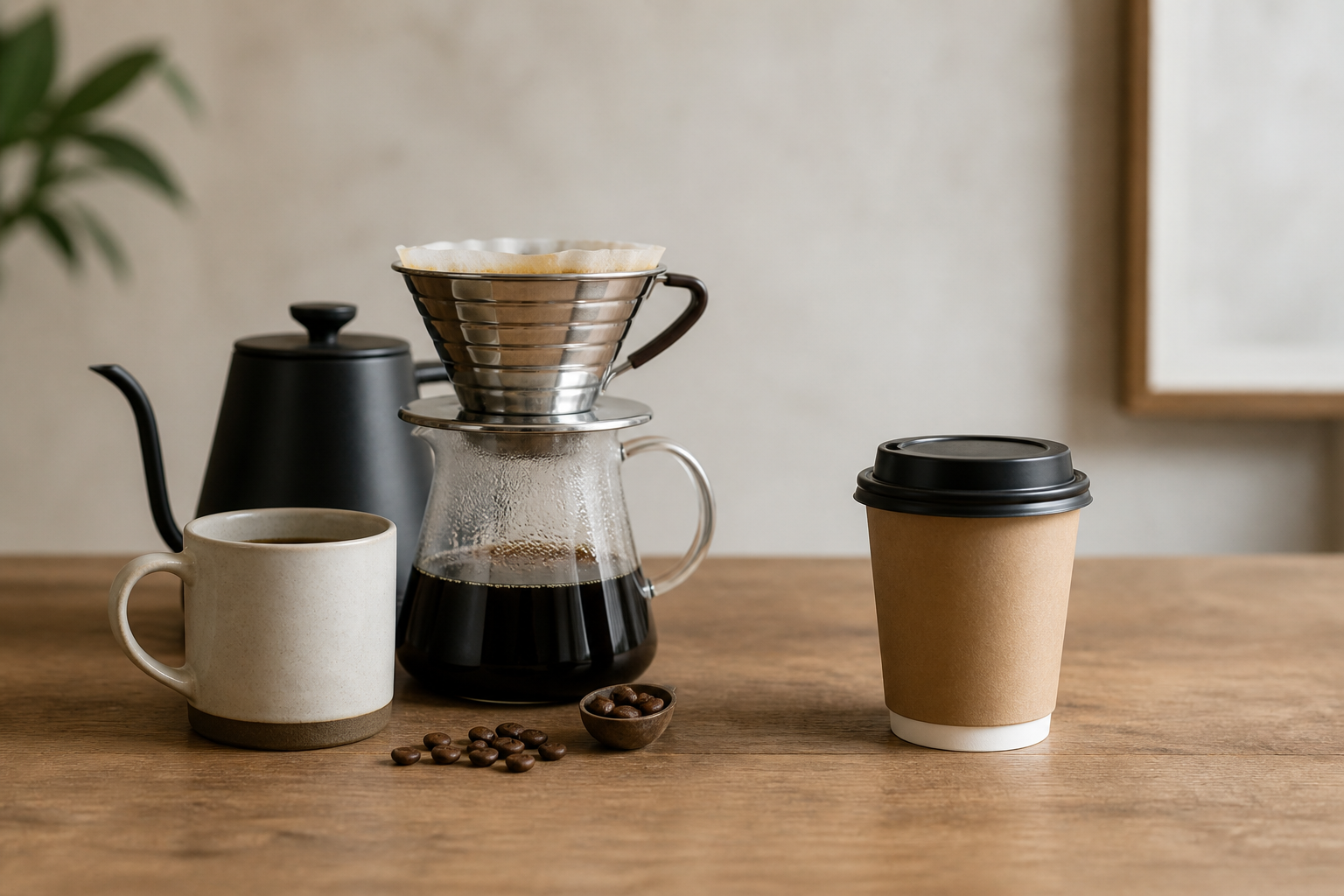
    A home pour-over set-up with kettle, carafe and mug on a wooden table at the left, and a lidded takeaway cup from a cafe at the right

    Coffee has several published prices, each measuring something different. A cost per cup gets assembled from three of them, plus a number nobody publishes at all. That last one is why the honest output here is a break-even counted in cups.

    The price of coffee is at least three different published series

    Start with the beans. The Bureau of Labor Statistics priced ground roast coffee at $9.317 per pound in July 2026, U.S. city average, not seasonally adjusted. That series covers supermarket ground coffee, all sizes. It is the broadest and cheapest tier on the shelf. It went out with the July CPI release on 12 August 2026.

    Advertisement

    The café side has no federal equivalent. BLS publishes no menu price for a hot coffee, so the comparison has to leave the government series behind. Toast, a restaurant point-of-sale vendor, puts the median at $3.77 for a regular hot coffee in July 2026. That is up 7.4% on July 2025. The figure is a payments vendor’s own published median, drawn from the menus of restaurants on its platform. It is the best number available for the job, and it does not carry the standing a federal series does.

    The third publisher supplies no price at all. SCA Standard 310-2021 fixes a brew ratio of 55 g of coffee per 1.000 kg of water. The Specialty Coffee Association wrote it. That URL is a public verbatim mirror, because the association’s own copy sits behind membership. The ratio is a test ratio, written to make brewers comparable under controlled conditions rather than as a recipe for your kitchen.

    A pound of supermarket ground makes about 23 defined cups

    Set the cup at 350 g of brewing water, a little under a 12-ounce mug. At the test ratio that draws 19.25 g of coffee. A pound is 453.6 g, so a pound yields about 23 cups. Call it a defined cup: the size the standard implies, not the size of your mug.

    At $9.317 a pound, 19.25 g of beans costs 39.5 cents. Those same 23 cups bought across a café counter at the median come to $86.71. The remaining lines cannot close that gap. They can still move the break-even.

    Electricity lands under a penny; the gear line is where the money sits

    The EIA puts the residential electricity price at 18.34 cents per kilowatthour for June 2026, released 26 August 2026. EIA is candid about the method. It calculates average retail revenue per kWh as a proxy for rates, because it does not collect retail rates directly. Assume, illustratively, 0.04 kWh to boil and brew one 350 g cup. That is seven tenths of a cent.

    Gear is the line that moves the answer, and it is the line nobody publishes. No national average exists for what a household spends on a brewer and a grinder. Inventing one would be worse than admitting the hole. So state the assumptions and divide.

    An illustrative $240 of equipment over an illustrative 4,000-cup life comes to six cents a cup. Four thousand cups is two a day for about five and a half years. Substitute your own two numbers; the method is the durable part. Purchase price divided by the cups it will make before it dies is the whole of it. The case that the grinder is the first upgrade worth making of it is argued elsewhere on this site.

    LineCost per cupFigure behind itSourceSource period
    Beans, 19.25 g at the test ratio$0.395$9.317 per lb, ground roast, all sizesBLS Average Price Data, series APU0000717311July 2026
    Electricity — ILLUSTRATIVE energy use$0.0070.04 kWh (illustrative) at 18.34 cents/kWh (published)EIA Electricity Monthly UpdateJune 2026 data
    Gear amortisation — ILLUSTRATIVE$0.060$240 over 4,000 cups, both figures assumedassumption, no published series existsn/a
    Home cup, total$0.462sum of the three lines abovemixed, incl. ILLUSTRATIVE rowsn/a
    Café, one regular hot coffee$3.770median menu price on one vendor’s platformToast, Inc. Menu Price MonitorJuly 2026
    Difference per cup$3.308café median less home total, which includes ILLUSTRATIVE rowsderivedn/a
    Beans: U.S. Bureau of Labor Statistics, Average Price Data series APU0000717311, “Coffee, 100%, ground roast, all sizes, per lb. (453.6 gm), U.S. city average, not seasonally adjusted”, July 2026, published with the CPI release of 12 August 2026 and retrieved from the BLS public data API on 8 September 2026. Café: Toast, Inc. Menu Price Monitor, a point-of-sale vendor’s own published median drawn from its platform’s menus, published 11 August 2026, fetched 8 September 2026. Electricity price: U.S. Energy Information Administration, Electricity Monthly Update, June 2026 data, released 26 August 2026. Cup defined as 350 g of water at the 55 g per 1.000 kg test ratio in SCA Standard 310-2021. Rows marked ILLUSTRATIVE use assumed figures chosen to demonstrate the method; they are not published data and should be replaced with your own.

    Seventy-two cups repays the illustrative gear budget

    Once the gear is bought, it is spent. What governs the decision afterwards is the marginal cup: beans plus electricity, 40.3 cents. Against a $3.77 median that saves $3.37 every time. So $240 of illustrative gear repays itself in 72 cups, which is about five weeks at two cups a day.

    Now run it on a specialty bag. Assume double the BLS per-pound price — an assumption, since no published series tracks specialty retail this way. The bean line goes to 79 cents and the marginal cup to 79.8 cents. The saving falls to $2.97 and the break-even moves to 81 cups, roughly six weeks. Doubling the bean price barely dents the payback period, because the café median is so far above both.

    Advertisement — advertiser disclosure

    The café is also selling labour, rent and a chair

    The table prices inputs. A café prices inputs plus a barista’s hour, a lease, a service contract, and somewhere to sit. Subtracting one from the other measures one thing and implies another. A piece that skips that is doing sleight of hand.

    There is a quality axis too, and it does not run parallel to the cost axis. Water treatment, grinder consistency and a machine that holds its temperature are part of what $3.77 buys. Why your coffee tastes different at home than at the café takes the same comparison down that side of it.

    The table also omits consumables it cannot source. Paper filters and tap water have no published per-cup series behind them. They are small. They are not zero, and treating a table as complete because it adds up is how this genre goes wrong.

    The short version

    Swap the two assumed lines and the break-even moves; the gap does not close

    The gear line and the electricity line are assumptions, labelled as assumptions, because nothing published covers them. Swap in your own and the break-even in cups moves with them, up if the kit cost more and down if it cost less. What does not move is the distance between forty-odd cents and $3.77, because that distance is set by two published series and neither of them is your equipment. Both series move month to month, so re-read them before trusting the number.

  • Direct Trade vs. Fair Trade Coffee and the Promise Each Label Makes

    Direct Trade vs. Fair Trade Coffee and the Promise Each Label Makes

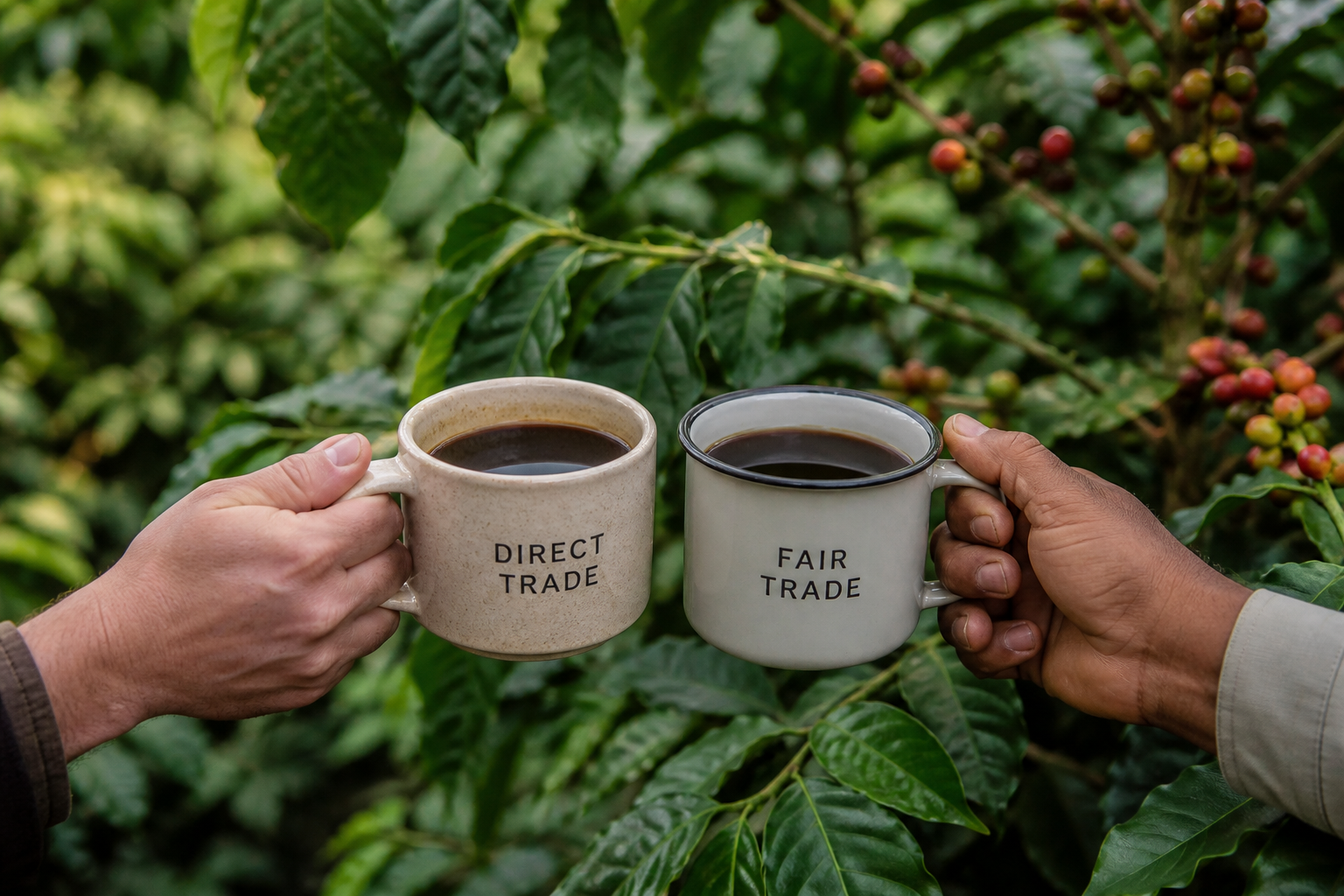
    Two hands each holding a plain mug of black coffee, one lettered DIRECT TRADE and the other FAIR TRADE, in front of a coffee shrub hung with ripening red and green cherries

    Two bags of coffee sit on a shelf. One says “Fair Trade Certified.” The other says “Direct Trade.” A shopper might assume these labels mean the same thing. Farmers got paid fairly, and someone checked. They don’t mean the same thing at all. One is a certification with a written standard, an independent auditor, and a published price floor. The other is a phrase a roaster can print on a bag with nobody checking a word of it. Knowing what each label leaves out matters more than most shoppers realize.

    What Fair Trade Certification Guarantees

    “Fair trade” isn’t one thing. It’s two separate certification systems, run by two different organizations, with two different price floors. Most bags don’t say which one applies. Fairtrade International, the Bonn-based group behind the original label, sets a minimum price. Farmer cooperatives must be paid that floor no matter how low the commodity market falls. For contracts signed on or after Dec. 1, 2026, that floor rises to $2.00 per pound for washed arabica, up from $1.80. A fixed $0.20-per-pound premium and a $0.40 organic differential come on top, according to the trade publication Daily Coffee News. Fair Trade USA is a separate organization. Its own history page dates the split from the international system to 2011, and, according to the certifier’s own coffee page, it runs its own standard: a guaranteed minimum of $1.40 per pound for washed arabica, plus a $0.20 social premium. Two certifiers, two different numbers, the same words on the bag.

    Advertisement

    Both systems require more than a price. Certification standards prohibit forced and child labor. They also require farmer organizations to meet business-capacity rules before they’re approved at all. But the premium doesn’t land directly in one farmer’s pocket. It’s paid to the cooperative instead, which votes on how to spend it – a warehouse, a cupping lab, a school, a loan fund. Advocates see that as the point: cooperatives make their own spending decisions, not a roaster. It also means the extra $0.20 a consumer imagines reaching one farmer’s hand more often becomes shared infrastructure.

    Where Fair Trade Certification Falls Short

    The most cited critique isn’t corruption. It’s a supply-and-demand mismatch. Fair trade coffee is a small share of the global specialty market. Cooperatives often grow more certified coffee than buyers want at the fair trade price. Research summarized in the Stanford Social Innovation Review, a Stanford-published magazine, found this creates a perverse incentive. Cooperatives route their lower-grade lots into the fair-trade channel, where the floor price applies regardless of cup quality. They sell their best beans on the open market instead, for more money. The certification doesn’t reliably signal quality in the cup. Whether it raises farmer income overall is a separate, genuinely contested question among agricultural economists – not a settled one.

    Direct Trade Coffee Meaning — And What It Doesn’t Guarantee

    “Direct trade” emerged in the 2000s as specialty roasters’ answer to fair trade’s limits. The idea: buy straight from a farm or mill, skip the middlemen, pay for cup quality instead of a commodity floor. Here’s the catch. Direct trade coffee has no legal definition. There’s no certifying body, no published standard, no third-party audit. The trade publication Perfect Daily Grind reported that the phrase “has no formal definition or certification.” Traders and roasters, it found, don’t necessarily have to substantiate that they bought coffee directly from farmers.

    That doesn’t make direct trade meaningless. Some roasters maintain real, multi-year relationships with individual farms. They pay well above any certification floor and publish the prices to prove it. But nothing stops a roaster from printing “Direct Trade” on a bag sourced through a conventional exporter, with no farm relationship at all. That’s exactly why trade press treats the phrase as marketing language first, a sourcing model second. It only earns the second label when a roaster backs it with an actual price and an actual name at origin.

    Direct Trade vs. Fair Trade Coffee: A Side-by-Side Comparison

    A short comparison, stripped of marketing copy:

    Written standard: Fairtrade International and Fair Trade USA both publish detailed rules. Direct trade has none.

    Third-party audit: Both fair trade certifiers use independent auditors. Direct trade relies on the roaster’s word.

    Minimum price: Fairtrade International guarantees $2.00/lb for washed arabica, for contracts signed on or after Dec. 1, 2026. Fair Trade USA guarantees $1.40/lb. Direct trade has no floor at all – it can pay more, or less, than either.

    Cup quality: Neither fair trade system grades for quality. Direct trade often correlates with higher quality, since roasters hand-pick lots. Correlation isn’t a guarantee, though.

    Where the money goes: Fair trade premiums go to the cooperative, which decides collectively. Direct trade payments usually go straight to the farm or mill owner. That can mean more money for that individual grower – or less for workers who aren’t owners.

    Advertisement — advertiser disclosure

    What This Means for the Cup You’re Buying

    Neither label is a shortcut to an ethical purchase. Neither is a scam, either. Fair trade certification buys a verified price floor and real labor protections. The cost: a system that doesn’t guarantee quality, and doesn’t always turn into higher farmer income once cooperative overhead is counted. Direct trade buys the possibility of a genuine relationship and real transparency. That only holds when the roaster actually practices what the word implies, and discloses what it paid. The only way to know which you’re getting is to ask a plain question: what price did the roaster pay, and can they show it? A bag that answers that honestly, certified or not, does more than any label on its own.